Tuesday, October 27, 2015

From Okinawa to the UN, the Protest Against a US Military Base Continues

From Okinawa to the UN, the Protest Against a US Military Base Continues     
Global Voices: 27 October 2015


Long-held American plans to build a new military base in a remote part of Japan are being fiercely resisted by the people of Okinawa and their governor Takeshi Onaga. On October 13, 2015, Onaga exercised his right as governor to revoke a permit the US military needs to build the new base, effectively putting an end to base construction.

The move by the governor of Okinawa to block the base came after Onaga spoke at the United Nations Human Rights Council in Geneva before a large number of Japanese journalists and observers on September 21 about Okinawans’ opposition to the plan.

It was the first time a Japanese prefectural governor had ever addressed that council, and happened shortly after a UN official had admonished Japan for human rights violations in Okinawa itself.

‘Sounding an alarm’ about human rights violations

Onaga attended the UN human right panel in Geneva to “sound an alarm” about the relocation of the US Marine Corps Air Station Futenma in Okinawa to Henoko, an area further north within the prefecture, itself an archipelago located in Japan's far southwest.

Onaga said Okinawans’ right to self-determination has been ignored by Japan's central government in Tokyo, which had negotiated with the US Marine Corps to move the base.

There has been serious concern that construction of the new US military base would cause severe damage to this biologically invaluable area. Henoko Bay is known for its endangered species such as the dugong, a marine mammal found nowhere else in Japan, and rare blue coral (Heliopora coerulea).

The majority of residents oppose the plan, according to various polls throughout the years, but a small number of Okinawans do support the construction of a new base. Despite accounting for just 0.6% of Japan’s territory, Okinawa is home to over 70% of American military installations based in Japan. US military bases occupy at least 18% of the main island of Okinawa.

"20 years since the protest meeting against US solders’ rape case. Now 80% of Okinawan support Governor Onaga's protest against US base relocation to Henoko"
Okinawans have resisted the relocation of the base for 17 years, since a 1996 defense policy review suggested the move, and the American presence is still widely resented in Okinawa. Following a 2013 decision to formally move ahead with the Henoko move, protests have occurred in front of military bases almost non-stop.

Military bases amount to ‘discrimination’ against Okinawans

Onaga's address to the UN Human Rights Council in September came after an August 2015 visit to Okinawa by Victoria Tauli Corpuz, a UN special rapporteur on the rights of indigenous people. While in Okinawa Corpuz said that the presence of so many US military bases in the small, isolated prefecture amounts to discrimination against the people of Okinawa.

Since being elected governor of Okinawa in November 2014, Onaga himself has made every effort to prevent the relocation of the base, currently located in the middle of Ginowan city on the southwestern end of Okinawa island. Realizing that neither the US nor the Japanese governments were willing to address the concerns of Okinawans, Onaga decided to reach out to the international community to raise awareness of the issue in September:

"After World War Two, the US Military took our land by force and constructed military bases in Okinawa. We have never provided our land willingly. Okinawa covers only 0.6% of Japan, however, 73.8% of US exclusive bases in Japan exist in Okinawa […] […] Our right to self-determination and human rights have been neglected. Can a country share values such as freedom, equality, human rights, and democracy with other nations when that country cannot guarantee those values for its own people?"
Onaga's entire address in English can be watched here.

Governor's speech lauded by activists back home

Onaga's speech to the UN human rights council received applause from activists back in Okinawa. Jinshiro Motoyama, an Okinawan student acting aligned with Japan's SEALDs student movement, said:
"Mr. Onaga's speech was good. Thank you! Go Governor Onaga"
SEALDs Ryuku, the local affiliate of the national student activist movement, also tweeted:

"Oh wow, Governor Onaga is going to meet the foreign correspondents’ club tomorrow [in Tokyo, after his return to Japan from Geneva]. I want Onaga to keep communicating Okinawa's message to the international community.
“The existence of the US military bases is the biggest reason for neglect of human rights and right to self-determination. It is really disappointing to hear that the Japanese government says military bases have nothing to do with human rights.” – Governor Onaga as he continues to lobby the UN."

Seventy years of damage caused by US military presence

Speaking to reporters in Geneva, Onaga pointed out that during the 27 years that Okinawa was under the direct administration of the US military following the end of the Second World War, US soldiers were responsible for a number of problems, including the rape of young girls, a plane crashing into a primary school and hit-and-run incidents.

After administration of Okinawa was returned to Japan in 1971 a large amount of toxic contaminants left behind by the US military was discovered, but Okinawa was unable to do anything about it due to the Japan-US Status of Forces Agreement.

US aircraft still fly even after 10 pm, contrary to agreements reached between the two governments, Onaga said. After complaints about aircraft noise were made to the Japanese Ministry of Defense in Okinawa, as well as to other Japanese government offices, Onaga said he was only told that these would be conveyed to the US.

After Onaga's lastest move in October of canceling the permit the US military needs to build the new base at Henoko, representatives of the Japanese government are seeking to have Onaga's decision suspended under the Administrative Appeal Act.

Sanae Fujita is an associate fellow of Human Rights Centre, University of Essex, UK. Based in the UK, Fujita traveled to Geneva in September 2015 to report on Okinawa Governor Takeshi Onaga's address to the United Nations Human Rights Council. Fujita attended a press conference Onaga held following the address.
 

Greenpeace condemns Japan government’s go-ahead for Okinawa military base

Greenpeace condemns Japan government’s go-ahead for Okinawa military base
Greenpeace International: 27 October 2015

Tokyo, October 27 2015 - Greenpeace Japan today condemned the Japanese government’s decision to allow construction of a military base in Okinawa to proceed, despite 80% of local people being opposed, and despite the fact that the Bay where the base will be constructed is home to 262 endangered species, including the rare Japanese dugong.

Two weeks ago, Okinawa’s Governor Onaga rescinded permission for the landfilling of Henoko Bay. Today’s announcement by the central government overrides the Governor, who is acting with the support of the Okinawan people, and ignores recent revelations that the Environmental Impact Assessment was not only flawed, but allegedly corrupt.

“This decision is an insult to the people who have worked so hard, for so long, to have their voices heard. It is shocking that the government is failing to protect Japan’s endangered species and trampling over the wishes of so many Okinawans. Any responsible government would press pause, and support a full investigation into this debacle,” said Kazue Komatsubara,  Greenpeace Japan Oceans Campaigner.

On 19 October this year, the Asahi Shimbun newspaper reported that contractors and consultants associated with the proposed construction of the military base in Henoko had made financial “donations” worth 11 million yen, which were accepted by three members of the government committee set up to oversee the EIA process. The Committee and process were set up by the Department of Defense, even though the DoD had a clear vested interest in getting the construction approved.

The Greenpeace flagship Rainbow Warrior is setting sail for Okinawa later this week, after accepting the invitation of local citizens’ groups and politicians for Greenpeace to pay a goodwill visit to the island. Greenpeace has stood with the people fighting the proposed relocation of this military base to Oura Bay in the past, with Greenpeace ships and crew acting in solidarity with local communities in 2005 and 2007, and have been actively working with local groups throughout 2015.

“We stand with the majority of Okinawans who are against the expansion of this base and demand the protection of Henoko Bay and the rare and vulnerable marine life that depends on it.”

Note to editors:  

On 27 October, 10 organisations jointly submitted a letter to the Defence Minister Gen. Nakatani, and Tamayo Marukawa, Environment Minister, addressing the flawed nature of the environmental assessment and strongly criticising the environmental monitoring committee, overseeing the landfill work of Henoko-Oura Bay.  Those 10 organisations are Greenpeace Japan, Ramsar Network Japan, Friends of the Earth Japan, Nature Conservation Society of Japan, Okinawa and Biodiversity Citizen Network, Okinawa Environmental Network, Save the Dugong Campaign Centre, Henoko relay, No Base in Churaumi and Yanbaru Citizens Group, and Peace Boat.

Tuesday, October 20, 2015

Americans disinclined to get involved in Asian conflicts

Americans disinclined to get involved in Asian conflicts
Nikkei Asia Review: 20 October  2015

TOKYO -- A survey by think tanks in the U.S., China, Japan and South Korea has revealed discrepancies among the four nations toward U.S. troops being deployed to Asia during times of crisis. While people in Japan and South Korea expect the American military to come to the rescue, the majority of Americans think otherwise.


When asked if the U.S. should deploy its military in the case of North Korea attacking South Korea, 91% of South Koreans said yes. In the U.S., however, the support ratio was 47%; lower than the 49% who disagreed.
 
The Genron NPO of Japan, The Chicago Council on Global Affairs of the U.S., the East Asia Institute of South Korea and the Horizon Research Consultancy Group of China surveyed 7,000 citizens about their perceptions toward Asia. The results were similar for scenarios such as if North Korea were to attack Japan (71% of Japanese say the U.S. should send troops, 48% of Americans agree) and if China and Japan were to clash over the Senkaku Islands, called Diaoyu in China (56% of Japanese and 33% of Americans agree U.S. troops should be sent).

 As for a Taiwan crisis, Americans and Chinese showed similar opposition to U.S. troop deployment, with 68% of Americans and 82% of Chinese opposed.  Were the Korean Peninsula to be peacefully united, 62% of Americans believe it would be time to either:
  • End the security alliance with the South and withdraw troops.
  • Or maintain the alliance but withdraw troops.
Only 32% of Americans said U.S. troops should remain in a united Korea, while 57% of South Koreans and 45% of Japanese said they would expect the Americans to stay.  The tide of U.S. public sentiment could be a reason South Koreans seem to be warming up to China. When asked which country was important to them, 98% of South Koreans said the U.S. was and 97% said China was too.

 "There seems to be a seam emerging between the U.S. and its allies South Korea and Japan, who we thought shared the same views toward national security," The Genron NPO said. "Compared to past surveys, South Koreans are clearly tilting toward China."

Monday, October 19, 2015

Fukushima: The View From Ground Zero. “Desperate Lives of Thousands Who Live in Limbo”

Fukushima: The View From Ground Zero. “Desperate Lives of Thousands Who Live in Limbo”
Global Research: 19 October 2015

Photographer and filmmaker Arkadiusz Podniesiński, who began visiting and photographing Chernobyl in 2007, documents his 2015 visit to the radiated zone around the Fukushima Daiichi Nuclear Power Plant.His photographs show the far-reaching and continuing effects of the triple disaster of March 11, 2011 compounded by earthquake, tsunami and nuclear meltdown. Podniesiński highlights both the desperate lives of thousands who continue to live in limbo, in government emergency housing, unable to return home, but also the plight of some who have chosen to return. (The Asia-Pacific Journal)

Radiation or Evacuation

Immediately after the disaster at the Fukushima power plant an area of 3 km in radius, later extended to 20 km, was designated for evacuation. Approximately 160,000 residents were forcibly evacuated and received government subsidies and temporary housing; others chose to flee without state support or housing provision. Chaos, and an inefficient system of monitoring radiation levels, resulted in many families being divided up or evacuated to places where the contamination was even greater than in the evacuation zone. In the months and years that followed, as radiation readings became more precise, the boundaries of the zone evolved. The zone was divided according to the level of contamination and the likelihood that residents would be able to return.

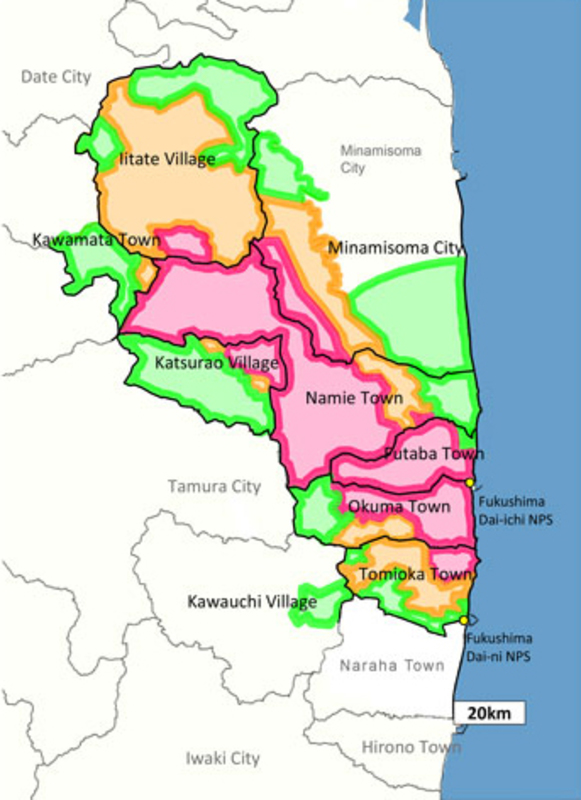
Fukushima Evacuation map showing differential radiation levels, September 2015

Four years later more than 120,000 people still cannot return to their homes, or what is left of those homes. Many of them continue to live in temporary government accommodations built for them. As with Chernobyl, some residents defied the order to evacuate and returned to their homes shortly after the disaster. Some never left.
 
Entry to towns and cities located in the zone with the highest levels of contamination, marked in red, is not permitted except by special permit. Due to the high level of radiation (> 50 mSv per year), no repair or decontamination work has been carried out there. According to the authorities’ forecasts the residents of those towns will not be able to return for a long time, if at all.
 
The orange zone is less contaminated but is also deemed uninhabitable, but with lower levels of radiation (20-50 mSv/y) clearing up and decontamination work is being conducted here. Residents are allowed to visit their homes but they are not allowed to live in them.
 
The lowest level of radiation (< 20 mSv/y) is found in the green zone where decontamination work has been completed. The clean-up is in its final stages, and the evacuation order is to be lifted soon.
 
Decontamination
 
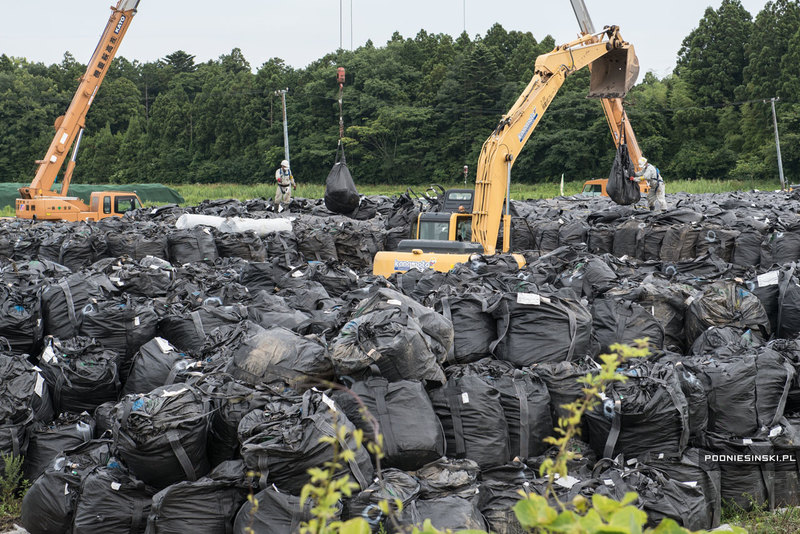
Dump sites with sacks of contaminated soil are usually located on arable land. To save space the sacks are stacked in layers, one on top of the other.
 
When entering the zone, the first thing that one notices is the huge scale of decontamination work. Four years later, twenty thousand workers are painstakingly cleaning every piece of soil. Removing the top, most contaminated layer of soil, they put it in sacks, supposedly to be taken to one of several thousand dump sites. The sacks are everywhere. They are becoming a permanent part of the Fukushima landscape.
 
Decontamination work is not limited to removal of contaminated soil. Towns and villages are being cleaned as well, methodically, street by street and house by house. The walls and roofs of all buildings are sprayed and scrubbed. The scale of the undertaking and the speed of work are impressive. The workers are making every effort to clean the houses so that residents can return as soon as possible.
 
The roofs of all the buildings are hand-cleaned tile by tile.
 
Some contaminated soil has been transported out of town, however, often only to the outskirts. This expensive operation is only shifting the problem from one place to another so that residents will be able to return.
 
It is still not clear where the contaminated waste will end up, especially as residents protest against location of long-term dump sites near their homes. Many are unwilling to sell or lease their land for this purpose. They do not believe government assurances that 30 years from now the sacks containing radioactive waste will be gone. They fear that the radioactive waste will be there forever.
 
Many areas cannot be decontaminated at all because of thick forests or because they are in mountainous areas. Only houses and areas surrounding houses, as well as 10-meter strips along roads, are being decontaminated. This gives rise to the fear that any major downpour will wash radioactive isotopes out of the mountainous and forest areas and the inhabited land will become contaminated again. These fears are not without foundation; in the last year this has happened at least twice in Chernobyl.
 
Given continue fears of radiation and the slow pace of cleanup, many residents who distrust the authorities and fear contamination do not want to return to their homes. A survey of former residents of the red zone shows that only 10% of those polled want to return to their homes, while as many as 65% of evacuees do not intend to return. Fear of radiation is hardly the only problem. Lack of work, infrastructure, and medical care are all effective deterrents to returning, and with each year, the residents get older, like the deserted houses whose conditions deteriorate the longer they are not renovated and lived in.
 
There are also reasons for the unwillingness to return that residents do not like to talk about, including the compensation and the various subsidies and tax relief that evacuees receive. Compensation for the accident alone was set in 2012 at 100,000 yen (approximately 850 dollars per month) per evacuee. The government has announced that compensation will end one year after a zone is officially opened as the green and orange zones presently are. Some residents have protested and are planning legal action against the government on the ground that the area remains unsafe. Many fear that the authorities will attempt to coerce them into returning, particularly since the government in 2012 arbitrarily raised the permitted level of exposure to radiation per year from 1 to 20 mSv.1
 
 
No-Go Zone
 
A separate permit is required to enter each of the towns in the red zone. Permits are issued only to those who have a legitimate, official reason to enter. No tourists are allowed. Even journalists are not welcome. The authorities, wary of journalists, enquire about the reason for visiting, the topic being covered, and the attitude of journalists towards the disaster.
 
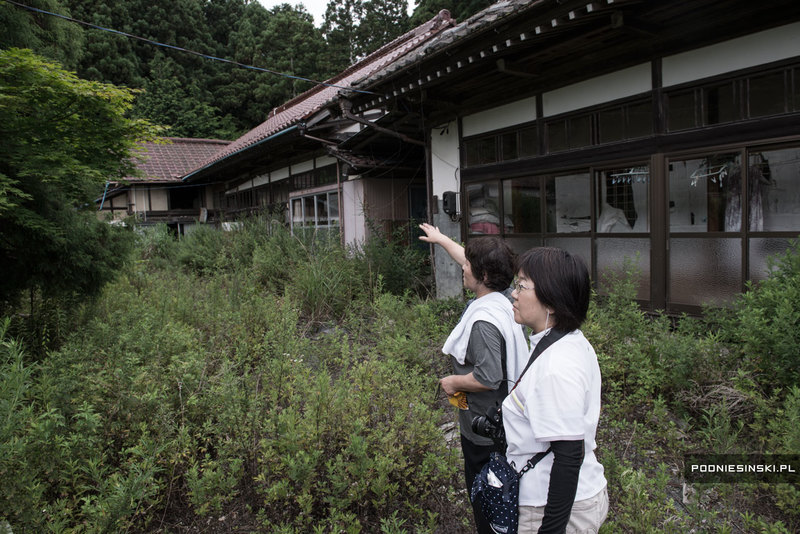
Unable to visit the red zone, I entered the orange zone. There, in Tomioka, I met Matsumura Naoto, a farmer who returned illegally not long after the accident to what at the time was still the red zone. He returned to take care of the abandoned animals, unable to bear the sight of herds of cattle wandering aimlessly in the empty streets when their owners had fled the radiation. He tells of animals that were starving to death or were being killed by the authorities.
 
Matsumura Naoto His blog can be read here
 
Learning that I visit Chernobyl regularly, Matsumura asks how the evacuation and decontamination were carried out in Chernobyl, and about the levels of radiation. It is still illegal for residents to return permanently to towns in the orange zone. They are only allowed to spend time there during the day, but even then there are few residents who do. Most do not want to return, and soon they won’t have anything to come back to. Many of the deserted houses, especially the wooden ones, are in such disrepair that soon it will be not be financially viable to renovate them, and if they are not renovated they will start to collapse.
 
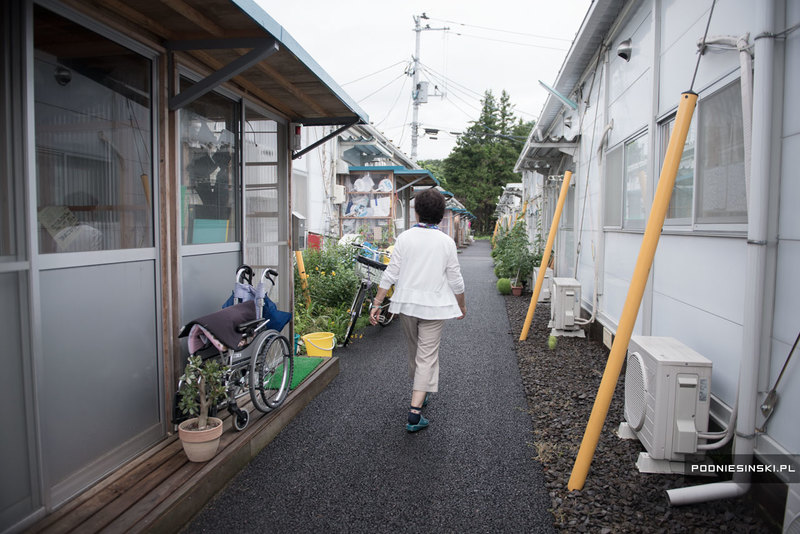
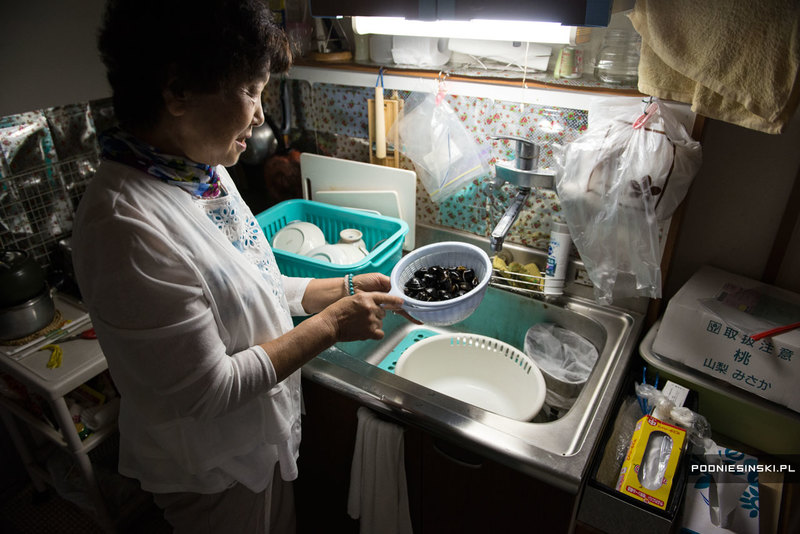
Young residents or families with children left Fukushima long ago. In pursuit of a better life, many went to Tokyo or other large cities. Many older residents, more attached to the place they have lived for several decades, prefer to live nearby, in specially built temporary housing. Others went to relatives, but not for long, so as not to be a burden. Most soon return to their temporary housing: two tiny rooms and a kitchen.
 
Nozawa Yōko’s temporary housing she was moved to after evacuation
 
Namie

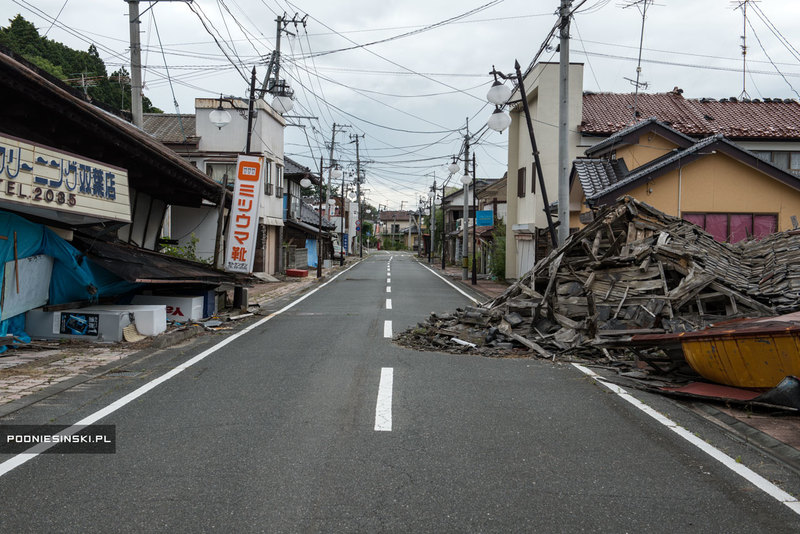
Although Namie, one of three towns in the no-go zone, is completely deserted, the traffic lights still work, and the street lamps come on in the evening. Now and again a police patrol drives by, stopping at every red light despite the area being completely empty. They stop our car and check our permits carefully.
Liquor store
 
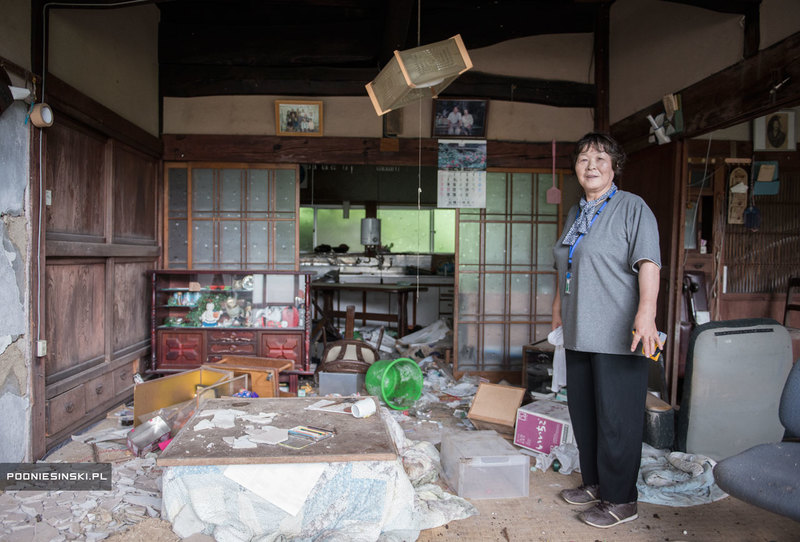
Here the earthquake did not seriously damage the houses, and being situated a long way from the sea there were also no threat from the tsunami. It was radioactivity that forced residents to flee.
 
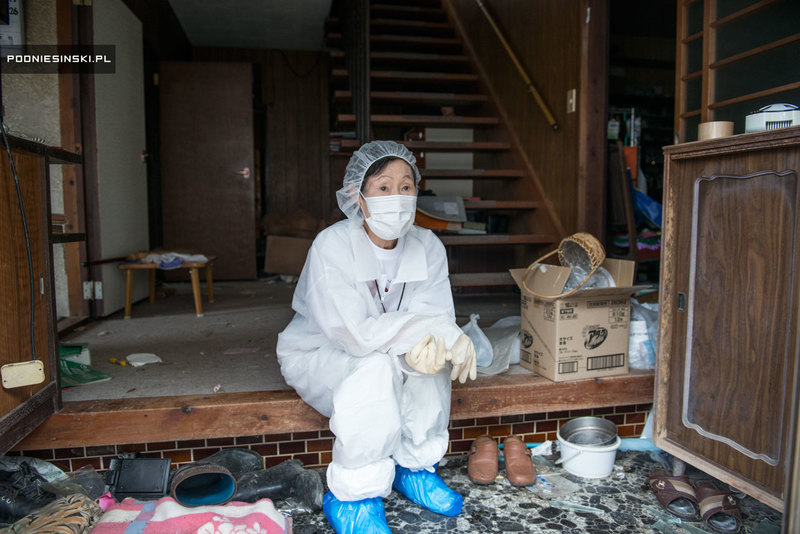
Tajiri Yukiko showing the wreckage in the house she lived in before evacuation
 
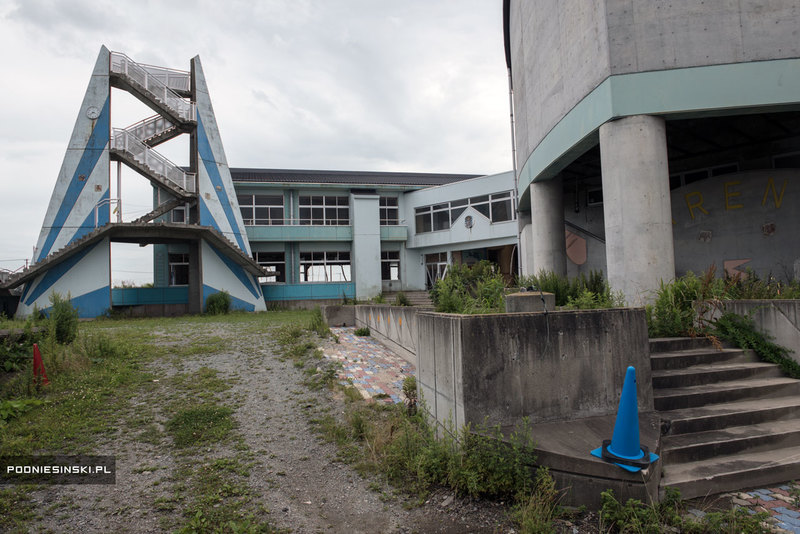
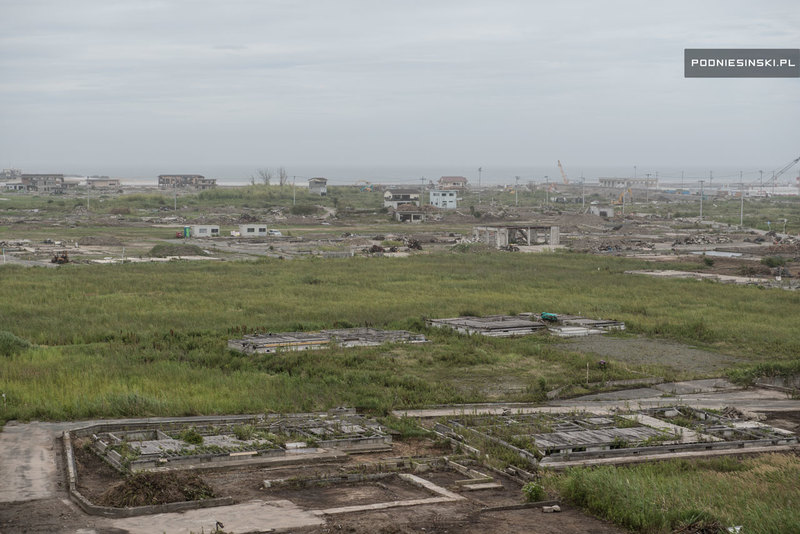
In order to see the effects of the tsunami we go to the coast, where all of the buildings were destroyed. Four years have passed. The clean-up is continuing, but most damage has been cleared. One concrete building stands out. A school built using TEPCO money withstood the destructive force of the tsunami. The children fortunately escaped to the nearby hills.
 
The Ukedo primary school building survived just 300 meters from the ocean.
 
Remains of destruction in the aftermath of the tsunami, seen from the school’s observation tower.
 
 
School computers
 
In one classroom on the first floor, a mark below the blackboard shows the level of the tsunami. On the blackboard are words written by former residents, schoolchildren, workers and soldiers to keep up the morale of the victims: “We will be reborn,” “You can do it, Fukushima!” “Stupid TEPCO.” “We were rivals in softball, but always united in our hearts!” “We will definitely be back!” “Despite everything, now is precisely the beginning of our rebirth.” “I am proud to have graduated from the Ukedo primary school.” “Fukushima is strong.” “Don’t give up, live on!” “Ukedo primary school, you can do it!” “If only we could return to our life by the sea.” “It’s been two years now and Ukedo primary school is the same as it was on 11 March 2011.”


A fissure in the earth caused by the earthquake in Yoshizawa’s farmland
 
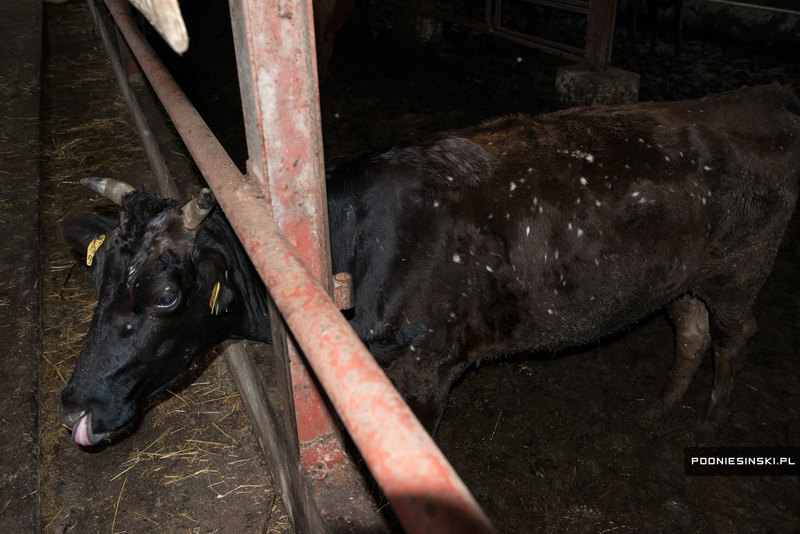
Yoshizawa Masami,like Matsumura, returned to his ranch shortly after the disaster to take care of the abandoned animals. Now there are approximately 360 cattle on his farm.
Not long after the accident his cows started to get mysterious white spots on their skin. Yoshizawa suspects that this is from eating contaminated grass. Trying to publicize the case, he has been in contact with the media, and has protested in front of the Diet in Tokyo, even taking one of his cows. However, apart from financial support for regular testing of the cows’ blood, extensive tests have not been conducted.
 
 
Namie at dusk. Despite being totally deserted, the traffic lights and street lamps still work.
 
Futaba

Futaba, which borders the ruined power plant, has the highest level of contamination in the no-go zone. There has been no clean up or decontamination due to high radiation. We were issued protective clothing, masks, and dosimeters.


Sign above one of the main streets of Futaba proclaims: “Nuclear power is the energy of a bright future”
 
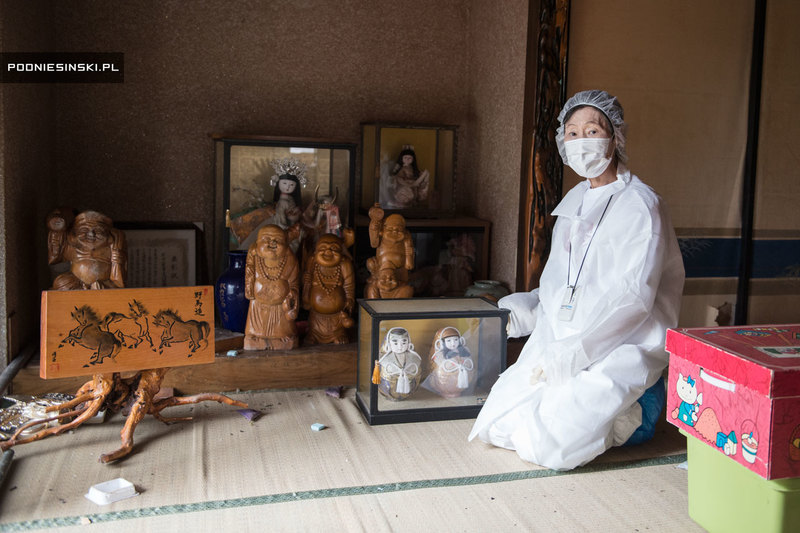
Tani Kikuyo (age 71) regularly visits the house from which she and her husband Mitsuru were evacuated, but they are permitted to enter only once a month for a few hours at a time. They continue to visit even though they have long ago given up hope of returning permanently. They check to see if the roof is leaking and whether the windows have been damaged by the wind or wild animals. Their main reason for returning however is a sentimental one.
 
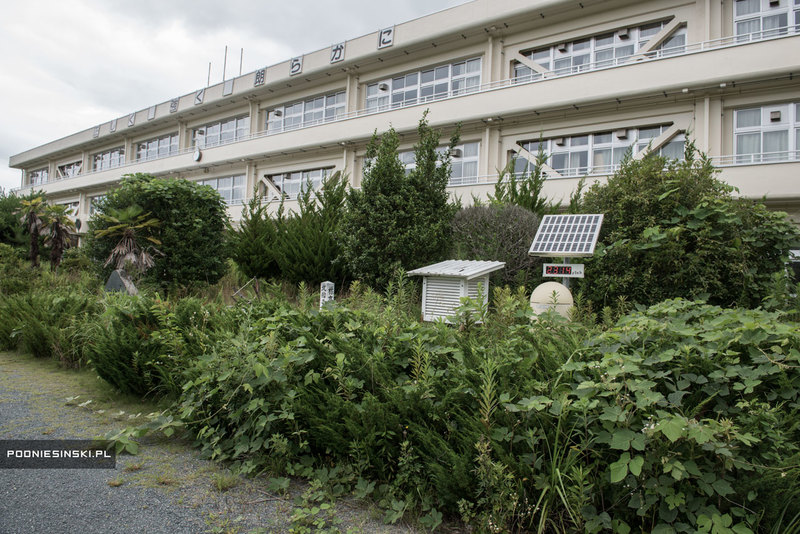
A school in Futaba. A dosimeter showing a radiation level of (2.3 uSv/h).
 
 
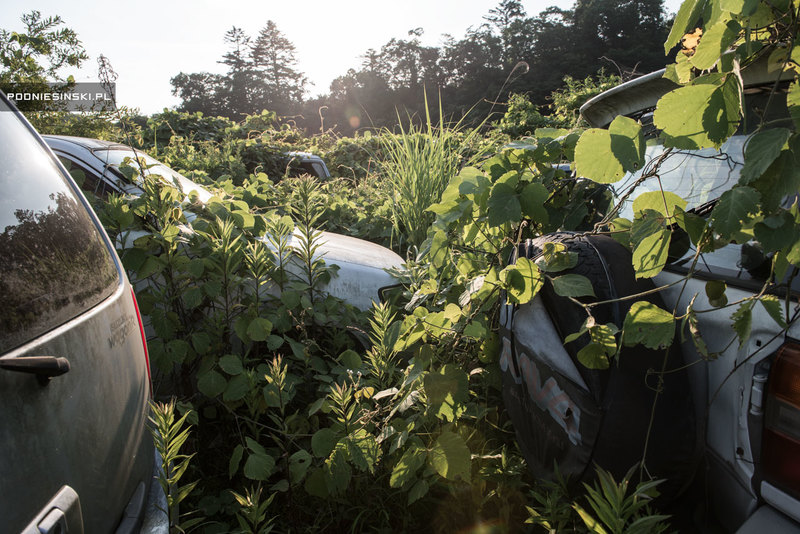
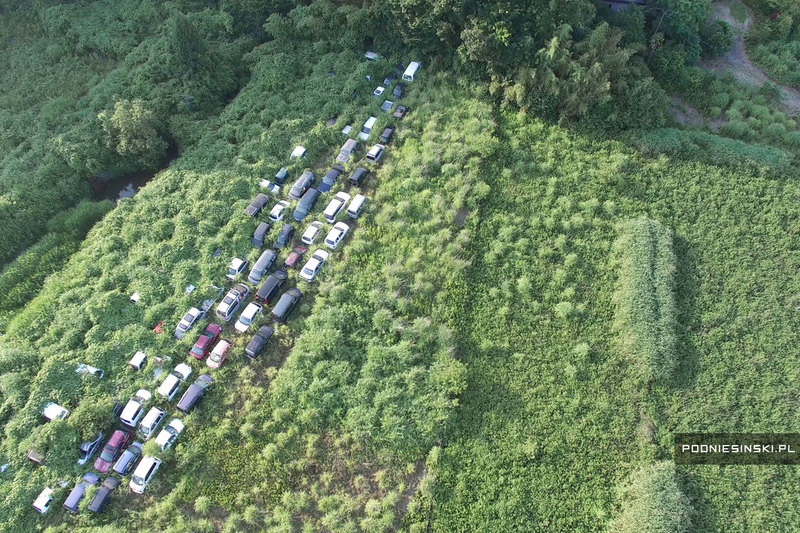
In the vicinity of the red zone, many abandoned vehicles are neatly organized in several rows. They are contaminated, releasing 6.7 μSv per hour.
 
Seven years ago I ended my first documentary on Chernobyl with these words:
“An immense experience, not comparable to anything else. Silence, lack of cries, laughter, tears and only the wind answers. Prypiat is a huge lesson for our generation.”
Have we learned anything since then:
See Arkadiusz Podniesiński’s full photographic essay on Fukushima here, and his work on Chernobyl here. See here also.


Friday, October 16, 2015

We Shall Overcome

We shall Overcome:  the documentary film produced by Chie Mikami

The Okinawa Islands――They constitute only 0.6% of Japan's land area, but are burdened with 74% of the nation's U.S. military bases.

A documentary that closely follows the people's struggle against the construction of a new U.S. military base in Okinawa, revealing not only their deep sadness and anger but also their warmth and humor

http://ikusaba.com/en/

SYNOPSIS

Towards the end of World War II, brutal ground warfare overwhelmed the Okinawa Islands. One in four Okinawans died, in a sacrifice of the lives of around a hundred thousand non-combatants.

Postwar, the U.S. military used its governance and force to construct military bases throughout Okinawa. Even today, 43 years since its reversion to Japan and 70 years since the war, the percentage of facilities exclusively for use by U.S. military and clustered in Okinawa comprise 74% of all such facilities in Japan, and tens of thousands of soldiers are stationed in the archipelago.

Now, as part of the construction of a brand new military base, plans are proceeding to build a landfill in a beautiful ocean where rare coral and the vanishing dugong make their home. Most Okinawans are opposed to this base, which would include the installation of a huge naval port and deployment of a hundred of the new transport aircraft known as the Osprey. The public has continued protesting, on sea and on land, trying to somehow stop the construction, while blocking their way are the Okinawa Prefecture riot police; Okinawans clashing head-on with other Okinawans, sundered by national policy. Okinawa's rage has boiled over. In the November 2014 election, ONAGA Takeshi became Governor of Okinawa in a landslide victory on a platform opposing new base construction. Even the House of Representatives results shoved Okinawa's base opposition in the face of the Japanese government. But the national policy remains in place. Tensions build daily at the scene of the protests, with injuries and arrests... What is actually going on right now in Okinawa?

Violent confrontations are not the only subject of this documentary. It also reveals the thoughts and histories of the local people who have had to live side-by-side with the U.S. military bases, the rich culture and way of life they have carefully nurtured in spite of Okinawa's harrowing history, and the singing and humor they have maintained even amidst intense struggle. The film poses Okinawa's wish to the world, that an end be put to seventy years at the mercy of conflict.

Director's Statement

Led to believe that the bases are for training and that Japan has not been at war in all this time, the Japanese people have conveniently looked the other way, but they must confront the laments of an Okinawa that has been trapped for seventy years. My nineteen years at an Okinawan television station made me keenly aware that the story had to be re-told with this in mind or it would not reach people. Okinawa, led by the Governor, is in an all-out confrontation with the State.

But what it wishes to stop is what the State of Japan seeks to bring back, war itself. Knowing this, Okinawa does not succumb. At the Henoko gates and on the sea, the face of authority assailing the people of Okinawa is transformed into the police, the defense bureau, and the coast guard. They restrain the unarmed protesters. But every person pinned down has a voice with which to sing. In an instant, the height of anger becomes laughter, and the people regain their spirits. As I shot this film, I sensed unmistakable tremors. The rumblings that this unified island-wide struggle have awakened will surely become a major earthquake, spreading to all of Japan, and then the world.

Wednesday, October 14, 2015

EDITORIAL: Enough is enough. Revise Status of Forces Agreement

EDITORIAL: Enough is enough. Revise Status of Forces Agreement
The Asahi Shinbun: 6 November 2012

Another suspected crime by a U.S. serviceman in Okinawa Prefecture has indisputably demonstrated the need to revise the Status of Forces Agreement (SOFA) between Japan and the United States, which gives special treatment to U.S. troops and civilian employees of the U.S. military in Japan.
The incident in question took place on Nov. 2 in Yomitan, a village on the main Okinawa Island of the southernmost prefecture. Before dawn, a drunken U.S. airman broke into a private home on the third floor of a building and punched and injured a male junior high school student, according to police.

Less than a month ago, two U.S. Navy sailors were accused of raping and injuring a local woman, also in the central part of the island.

The situation has become outrageous. Unsurprisingly, Okinawa Governor Hirokazu Nakaima has warned about the serious damage these back-to-back incidents involving U.S. servicemen could cause to the Japan-U.S. security alliance.

SOFA stipulates that Japan has the preferential right to try members and civilian employees of the U.S. armed forces if they commit crimes outside U.S. bases during their off-duty hours.

However, if such suspected criminals enter areas under the control of the U.S. forces, according to SOFA, the custody of the suspects remains with the United States until they are formally indicted by Japanese prosecutors. In other words, Japanese authorities cannot arrest them as part of their investigation toward indictment.

In the latest case, the U.S. airman was injured as he tried to make his escape through the third-floor window, and he was taken to a U.S. military hospital. If he had not been injured, he would have been arrested at the scene by Japanese police officers.

On Nov. 5, Okinawa prefectural police questioned the suspect after obtaining the consent of U.S. forces. The Japanese government should ask the U.S. military to hand him over to Japanese authorities.

But Chief Cabinet Secretary Osamu Fujimura has said there is “no need to request a pre-indictment handover” of the suspect.

After the rape of a schoolgirl by U.S. servicemen 17 years ago, which sparked a wave of protests in Okinawa, both Tokyo and Washington agreed to improve the implementation of SOFA to enable such a handover of suspects before indictment. But this provision only applies in principle to vicious crimes and is carried out based on U.S. considerations.

Indeed, the acts attributed to the airman do not legally represent a vicious crime. But imagine the horror the teenager must have felt when he woke up being attacked by a sturdy man who had broken into the room.

Now imagine the same thing happening in your home.

SOFA gives U.S. military personnel a variety of privileges. For instance, if U.S. forces say a crime was committed during on-duty hours, Japan cannot try the suspect under Japanese law even if the crime was committed outside U.S. bases.

Do the Americans still have the occupier mentality based on the perception that Okinawa was a prize of the war their country won through bloody battles? Is such a mentality, combined with the sense of privilege based on SOFA, a major factor behind the series of crimes that have been committed by U.S. personnel?

Yomitan has a history of inviting U.S. commanding officers to community festivals and welcoming visits by American servicemen to the events. The village declined to do so this year because of the latest incident. Many Japanese cherish their country’s relationship with the United States. But it is not a relationship of subordination.

It is odd that Japanese politicians who talk about Japan’s sovereignty regarding security and diplomatic issues eschew discussing problems of SOFA, which restricts Japan’s jurisdiction over crimes committed in its territory.

It should be remembered that the election platform of the ruling Democratic Party of Japan pledges to propose a revision to the agreement.

From Yokosuka rape to U.S. court victory, ‘Jane’ commits her 12-year ordeal to print

From Yokosuka rape to U.S. court victory, ‘Jane’ commits her 12-year ordeal to print
The Japan Times: 14 July 2014

Catherine Fisher was once just another foreign resident of Tokyo, living out her life in a middle-class neighborhood with her children. But in April 2002, the Australian native made the fateful decision to arrange a meeting with her boyfriend, Jerry, near the U.S. military base in Yokosuka, Kanagawa Prefecture.

The story of what happened next is now well known, thanks to Fisher’s rare and courageous decision to go public, first as simply “Jane” — her middle name — and later using her full name. In the back of her van, in a Yokosuka car park, U.S. serviceman Bloke Deans raped Fisher, leaving her shocked and bleeding. She managed to make her way to the local police station, where what she calls her second violation began.

Instead of taking her to hospital, the policemen forced her to look for the man who had just raped her. They took her back to the car park to “reenact” the rape and assault for a police photographer, apparently forgetting, she says, that the victim’s body is the most crucial part of the crime scene.
“It was so scandalously absurd,” she writes of the 12-hour post-rape ordeal in her new book, “I am Catherine Jane: The True Story of One Woman’s Quest for Justice.” Unable to hold on to her urine, she eventually flushed the evidence down the toilet. “These policemen were controlling me just like the man who had just raped me,” she remembers.

The book opens with the force of a punch to the gut by describing the assault and aftermath in graphic detail. Her attacker, she recalls, “grunted like a pig” as he mounted her. Later, wrapped in a blanket, she watched in horror as the policemen went through the formal procedures of assaults, measuring the car park with tape measures and asking her to point to where she was raped.

“I truly wished I were dead,” she writes, as her rage and frustration grew at the thought that all real physical evidence in the assault was ebbing away, “drip, drip, drip, as the camera went click, click, click.” She says she could feel the police branding her while they worked: “Lowlife. Trash. Slut. Whore.”

Twelve years later, Fisher still hurts from her treatment by the authorities.

“I was thinking, ‘How could this be happening in Japan?’ It was so hard to get through just one day, every day,” she told The Japan Times. The way she coped, she says, was by chain-smoking and drinking. “But I never took medication. It makes suicide more likely. And if you have it in your house, you can overdose on it.”

Deans was allowed to return to the U.S. and was honorably discharged, for reasons that remain murky. Fisher won a civil suit against him in a Tokyo court in 2004 but the ruling had no jurisdictional authority in the U.S. Last year, after tracking Deans in America for several years, Fisher finally persuaded a circuit court in the U.S. to enforce that judgment for rape against him.

Fisher’s insistence that the U.S. military had helped Deans evade justice and that the Japanese government did little to help her pursue him was strengthened in the Milwaukee County Circuit Court by a statement submitted by Deans in which he claims a U.S. Navy lawyer told him to leave the country. The U.S. court’s decision was a victory for Fisher, but one that left her physically, mentally and financially exhausted, she says.
“I had many nervous breakdowns,” she recalls. “I was completely suicidal. The way the police treated me, that should never have happened. I could have returned to Australia and closed my eyes, but somebody had to stand up.”

Fisher’s battle has made her a public figure of sorts in Japan, though she expresses surprise that the local media has rarely interviewed her. She says “dozens” of raped woman have got in touch to tell their stories.

“If they contact me, they have nowhere to go,” she says. “They always say, ‘Why did the police treat me like a criminal?’ ”

One woman even sent Fisher a series of mails claiming she too had been raped by Deans.
The messages, reprinted in her book, said Deans put guns to her head and told her she was his “property.”

“He raped me with the barrel of a shotgun and threatened to pull the trigger,” the woman wrote. “He will never go to jail for abusing me because I kept my mouth shut and made excuses, but at least hopefully the children that he has neglected and abused will find justice and you will too.”

Fisher is unclear, however, if much has changed since her ordeal, although several high-profile cases suggest Japanese courts are now more likely to convict American servicemen. Naha District Court, for example, sentenced two sailors to 10 years last year for raping a Japanese woman in October 2012.

But in a survey released this year, the Associated Press found a “pattern of random and inconsistent judgments” in more than 1,000 reports of sex crimes involving Japan-based U.S. military personnel between 2005 and early 2013. AP said that in some cases, commanders “overruled recommendations to court-martial and dropped the charges instead.”

Fisher says she still hears of cases where rape victims are refused treatment in police stations when they report the crime. She is still campaigning for 24-hour rape crisis centers, and for making rape kits mandatory in police stations and hospitals.

“There is a place to go if there is an earache or a backache, so why isn’t there a place to go to if you get raped?” she says. “It is because of the stigma attached to rape.”

But she says Japan now tries to involve the victims of crimes by U.S. military personnel in their investigations, rather than ignoring them — as she insists happened to her.

“I think U.S. military crimes are getting a bit more publicity now,” she says.
As for Fisher’s personal scars, the impact of her ordeal rippled out to damage those around her, including her Japanese ex-husband, who quietly listened to her story and then tried to kill himself.
“I realized that I had been so caught up in my own problems that I did not see how depressed he was,” she writes.

Her mother fell ill, and Fisher’s relationship with Jerry, her long-term partner, also collapsed under the pressure of her fight. Her three children had to watch their mother unravel over several years.
“I was in court every month. That’s 10 years of court cases,” she says. “I saw my family falling like dominoes around me.”

“By the time I finished the book I was ready to collapse. I had to go on a drip — I was iron-deficient. The impact affects every single person when someone is raped. We were evicted three times. I thought I couldn’t continue. Then I read this guy was raping a woman with his pistols, and I said, ‘I can’t give up now.’ ”

So the fight goes on, she says. In her quest to find out why her attacker was allowed to leave Japan and discharged in the middle of a rape case, she says she recently met the director of public affairs for the U.S. military in Japan. After some verbal jousting, she says the director “very nonchalantly” told her, “We believe that we have no gain in talking to you.”

The statement gives the lie, she says, to the U.S. military’s claims of zero tolerance of rape.
“The stories pouring in from around the world contradict this,” she writes. “Sweeping them under the carpet will never make them go away. It all begins to change when people admit that there is a grave problem at hand. I won’t give up.”

She says the book is part of her effort to “stamp out the crime called rape.”

“It’s a journey of my transformation,” she says. “I hope it will have an impact on other people and that people will read it and it will awaken something in them. It’s not easy to put my entire life out there for people to see. But I do hope, with this book, that things will change. The whole world can see this is what is going on, and we can no longer just hide the fact that these crimes are happening.”
“As for me, I’m just lucky that I came out of this alive.”