Ryukyu Shimpo/Global Research : 5 December 2014
The Battle of Okinawa
The last engagement between the armies of Japan and the United States, the Battle of Okinawa, was fought in the final stages of the Pacific War, predominantly on the main island of Okinawa, but also on other small islands in the vicinity.
The battle is generally defined as beginning on 1 April 1945 and ending nearly three months later on 23 June. While most American sources and textbooks used at schools in Japan frame the period of the battle this way, this is incorrect for two reasons. The first is that while 1 April is the date on which the main body of US forces landed on the main island of Okinawa, on 26 March U.S troops landed on the Kerama Islands just off Okinawa but within the prefecture. The awful tragedy that occurred there in which more than 700 local residents were either directly or indirectly driven by the Japanese military to take their own lives is a compelling reason why we should neither exclude nor place less emphasis on the landing and battle in the Keramas. Not only did the events that occurred there serve as a prelude to the devastation that the people of Okinawa would experience in the next three to four months of 1945, but they undeniably marked the first military action of the Okinawa campaign.
Another good reason is that on that same day, as soon as the US forces landed on Akashima in the Keramas, Adm. Chester W. Nimitz
, the Commander in Chief, US Pacific Fleet and Pacific Ocean Areas, issued US Naval Military Government Directive No. 1, by which the United States suspended Japanese sovereignty and assumed administrative control as an occupying power of all Japanese territory located on or south of latitude 30 degrees north.
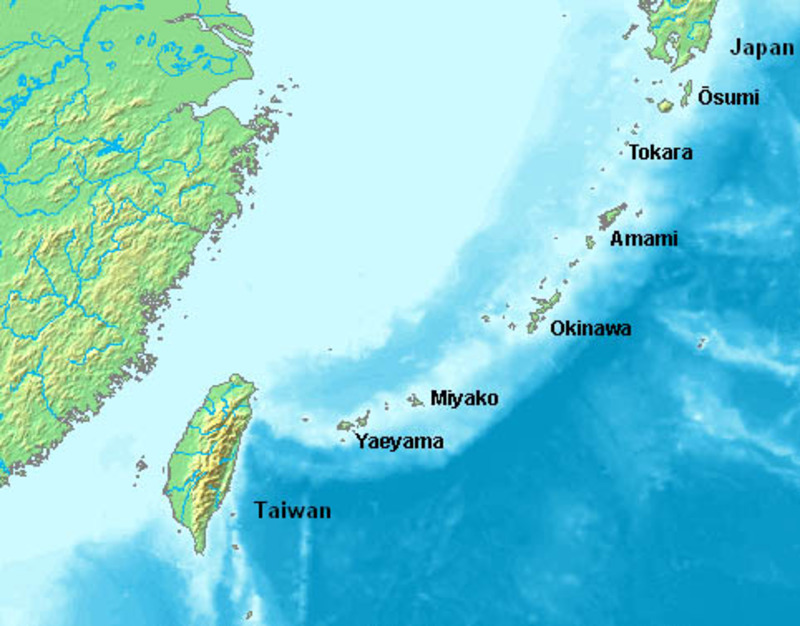
 Map of Okinawa and the Ryukyus Map of Okinawa and the Ryukyus |
Likewise, 23 June cannot be seen as the date when the Battle of Okinawa ended because this is the date when the Commander in Chief of the 32nd Army, Lt. Gen. Ushijima Mitsuru, and Chief of Staff Cho Isamu committed suicide on 22 June, the fact becoming known on the 232rd, but that was not the date when organized hostilities came to an end. As it happens, when General Joseph Stilwell, the Commander of the US 10th Army, the main force to land on Okinawa, was instructed by Field Marshal Douglas McArthur, the Supreme Commander of the Allied Powers, to receive the surrender of the Japanese forces in the Nansei Islands, among the Japanese representatives who presented themselves at Gen. Stilwell’s US 10th Army headquarters in Kadena on 7 September 1945 to sign the six documents that made up the instrument of surrender were Lt. Gen. Noumi Toshiro, the Commander of the 28th Division stationed on Miyako-jima, Maj. Gen. Takada Toshisada and Vice-Adm. Kato Tadao from Amami Oshima. The date of the signing was 7 September 1945 so it is only logical to see as the date when the Battle of Okinawa formally ended. By judging 23 June to represent the end of the battle, the terrible events that became known as the Kume-jima Incident, in which the Japanese military massacred local residents, therefore fall outside of the official historical parameters of the battle. It is also worth noting that American forces landed on Kume-jima on 26 June. In the Kume-jima Incident, after US forces landed on the island, the Japanese garrison killed 20 local residents who had supposedly engaged in “spying” for the enemy. This hideous occurrence represents one of the ugliest aspects of the Battle of Okinawa, and as such inclusion of this massacre is essential for the battle to be considered in its historical entirety. Therefore, we should date the end of the battle as 7 September rather than 23 June.
The Battle of Okinawa was distinct from all other battles in the Pacific War in that it was fought in one of the 47 prefectures of Japan, with the majority of the resident civilian population still present. While Iwo-jima, the island that served as a stepping-stone to Okinawa for US forces, was also Japanese territory, its residents had been forcibly evacuated months before, so the only people on the island when the US forces landed in February 1945 were the Imperial Japanese Army (IJA). The fighting in the Battle of Saipan in the middle of the previous year saw many Japanese settlers (mostly Okinawans) caught in the crossfire, but the Mariana Islands were not inherently Japanese territory. The islands had been controlled by Germany until World War 1 and in 1922 were entrusted by the League of Nations to Japan as mandate territories. While the people living in urban centers on the main islands of Japan were of course victims of merciless incendiary bombing in the latter stages of the war, Okinawa was the only prefecture to experience combat on the ground.
The scale of Operation Iceberg and the disparity in the size of the respective forces is noteworthy. The United States mobilized approximately 1500 naval vessels carrying 548,000 men to launch the invasion of the small islands of Okinawa. In 1945 the population of the prefecture of Okinawa was less than 450,000 people so the total US forces actually outnumbered the residents of Okinawa. In contrast to the huge numbers of US troops available, if we include the locally recruited and poorly trained Home Guard and Student Corps child soldiers, the Japanese forces deployed on Okinawa numbered 110,000, just one-fifth of the American strength.
The horrifying extent of civilian casualties is a key feature of the battle. Over 140,000 people, or about one third of the population, died in the course of the battle and its immediate aftermath. As documented in the articles that make up this book, hundreds of families were completed wiped out. Needless to say, most families in the prefecture will have the name of at least one deceased relative engraved on the Cornerstone of Peace, the marble tablets in Mabuni that bear the names of the more than 240,000 combatants and non-combatants of all nationalities who died in the battle. Among the civilian casualties were members of the Home Guard, as well as teenage soldiers recruited without any basis in law into the Blood and Iron Student Corps and young girls co-opted into nurse’s aide units. Among the civilian deaths was the significant loss of life of Korean young men and women press-ganged into serving as laborers or comfort women.
Another characteristic of the Battle of Okinawa was the incidence of group suicide and parricide among civilians terrified at the prospect of being captured by an enemy portrayed by Japanese soldiers as monsters. This had also occurred in Saipan the previous year, and the Japanese media, by extolling those who took their lives in this way, helped to set the scene for it to occur in Okinawa. While the extent to which Japanese soldiers were involved in encouraging or even compelling locals to take their own lives or kill loved ones has been the subject of heated debate in recent years, including court cases initiated by relatives of Imperial Japanese Army commanders suing for libel. This work covers some of these tragedies.
The use of “special-attack units” (kamikaze) is also a well-known aspect of the battle. Over 3,000 young men lost their lives carrying out suicide attacks on ships of the U.S fleet sitting off the coast of Okinawa and 4,900 US sailors were killed as a result. In an era when suicide bombers are painted as religious fanatics, it is important to understand that by and large the pilots who flew on the one-way missions to the seas off Okinawa were relatively well-educated young men driven to contribute to saving their country from what they believed would be obliteration. After all, in the months before the Battle of Okinawa Japan’s urban centers, and tens of thousands of their residents, were being incinerated at a pace that seemed to give credence to the call that only a Divine Wind (kamikaze) could save the nation from destruction. Japanese military leaders, and the Emperor, believed that one last furious roll of the dice would see the United States and its allies accept peace terms that allowed Japan’s national polity (its national essence with the emperor at the head) to remain in place. As it happens of course, rather than helping to bring the war to an end on acceptable terms, the ferocity of these kamikaze attacks resulted in pressure being brought to bear by the US Navy on the commander of the ground forces on Okinawa, Lt. Gen. Buckner, to bring the land campaign to an end as quickly as possible. This, it is argued, may have seen him opt for a costly, blunt-instrument approach rather than a slower but less costly second landing.
If we look at losses suffered by both sides in the Battle of Okinawa, while the US forces lost more than 12,000 men killed (with a total of 72,000 either wounded or victims of combat fatigue), the Japanese military lost over 70,000 men with more than 140,000 Okinawans being killed. In addition 10,000 Japanese soldiers were taken prisoner. When describing the battle, Hanson W. Baldwin of the New York Times wrote: “Never before had there been, probably never again will there be, such a vicious sprawling struggle.” In every sense of the word, the battle was vicious in the extreme. That the commanders of both sides died in the battle is testimony to the all-encompassing reach of the casualties.
The horrific death toll and the fanatical resistance by Japanese forces affected the thinking of US leaders and was a significant factor leading to the decision to drop atomic bombs on mainland Japan.
Another feature of the battle was that Okinawa was a “sute-ishi” (sacrificial stone in the Japanese board game of go) cast away in a desperate attempt to save the main islands of Japan. The Japanese Imperial Army’s objective was not to protect the local Okinawans, but instead to engage in combat for the longest time possible, and to inflict the maximum casualties on the Americans in order to earn time for further defensive preparations on the home islands. Rather than putting efforts into evacuation or the creation of a safe zone for civilians, the Okinawan people were used as a source of labor to build shelters, tunnels and other emplacements, to supplement combat units and to tend to wounded soldiers in circumstances aptly described by the title of this book. With the Imperial Japanese Army supplying itself in the field, having civilians close at hand suited them until the US forces landed, when the common view among the commanders of the 32nd Army changed to civilians being potential spies or merely bodies taking up space in caves and shelters.
The Japanese Army’s heartless approach to ejecting local civilians from caves was matched by their killing hundreds, perhaps even thousands, of their own soldiers who were too badly wounded to retreat southwards from hospital shelters.
Through the Battle of Okinawa the people of the prefecture learned a valuable lesson. They came to understand that the military was motivated solely by its own organizational imperatives, existing to protect abstract concepts of national polity and the imperial system, and that in no sense did it serve the function of protecting the lives of non-combatants, that is, the Okinawan people. The fact that that lesson was learned at the expense of well over 140,000 Okinawan lives means that even now, nearly 70 years after Japan was defeated in WW2, the people of Okinawa still value that lesson and sincerely strive to create a peaceful world.
It is important for English speaking readers who read Descent into Hell to understand that the origin of all current affairs is to be found in past history. Those who look at the situation that prevails in Okinawa now and sense a growing antagonism among the prefecture’s residents towards the presence of US military bases need to be reminded that it was not always like this. Today’s situation can be traced back firstly to the Battle of Okinawa and then to subsequent agreements between the governments of Japan and the United States.
We should remember that from even before the end of the battle, while the residual elements of the Japanese 32nd Army were forcing Okinawans out from caves into the relentless bombardment in southern Okinawa, specially organized units of the United States military were already providing food, clothing and shelter to displaced residents in areas that it had secured. The US forces had planned ahead and prepared for this contingency and their kindness in this respect no doubt saved tens of thousands of Okinawans from death by starvation. The years immediately following the surrender of Japan were marked by strong of feelings of gratitude among Okinawans towards the United States for its efforts to avoid a humanitarian disaster. These feelings continued until the governments of Japan and the United States colluded to concentrate an unfair proportion of the US military presence in Okinawa, including nuclear weapons, and highly toxic defoliants for use in the Vietnam War. The current situation in Okinawa may give the impression that ill feeling has prevailed for much longer than is actually the case. I encourage all who have an interest in Okinawan affairs to equip themselves with a knowledge of the civilian experience in the battle for these islands fought almost seven decades ago.
Evacuation
With the fall of Saipan imminent, on 7 July 1944, an emergency meeting of the Japanese cabinet ratified the request from Lt. Gen. Cho Isamu, Chief of Staff of the 32nd Army that the elderly, as well as women and children, should be evacuated from Okinawa, Miyako-jima and Ishigaki-jima.
1 In the course of the following week instructions were issued by the Japanese government to evacuate 80,000 people from the main island of Okinawa to Kyushu, and a further 20,000 from Miyako-jima and the Yaeyama Islands to Taiwan.
2 It has been suggested that the figure 100,000 was chosen because that is the number of soldiers who had been deployed to Okinawa, so acquiring food supplies for them meant that the same number of locals needed to be removed.
3 That was particularly pressing given that most livestock on the island had been slaughtered and eaten.
4 Also, the military decided that in an island prefecture as small as Okinawa, that the number of civilians who could not assist Japanese forces to conduct the battle should be reduced.
For several reasons the evacuation did not go smoothly. First and foremost, was that the military saw the civilian population only in terms of what food resources they could supply (or consume) or what tasks they could carry out to aid the defense of the island in construction or combat roles.
5 Regardless of any plan for evacuation, civilians were kept working as long as possible building airfields then digging tunnels and fortifications.
6 By March 1945 the military and able-bodied civilians had assumed one integrated purpose (
gunmin-ittaika) and evacuation to safety did not fit in with this philosophy.
7 Statements in the early months of 1945 by Lt. Gen. Cho were blunt and to the point – those who were not capable of contributing to the military effort were expected to remove themselves from locations where they might hinder military operations, and those who remained were expected to give their lives for the cause. At an address in Shuri on 10 January 1945, he is reported to have said, “To the people of Okinawa, as Japanese citizens you are expected to come forward to do your utmost to defend your homeland. … The young and the old are to cooperate by evacuating so that they do not interfere in the fighting.”
8
However, soldiers often discouraged people from evacuating by denigrating the act of relocation to Kyushu, where food was already in short supply, as cowardice.
9 Third, because the IJA talked only in terms of certain victory over the American forces, the civilian population did not sense the need to evacuate.
10 Fourth, the main premise upon which evacuation was carried out was that the people going to Kyushu had relatives or friends upon whom they could rely for support.
11
In the background to this was the sinking of the
Tsushima-Maru by the submarine USS Bowfin on 21 August, 1944 with the loss of 1,375 lives, including 777 children, highlighting just how dangerous the waters between Okinawa and the main islands of Japan had become by mid-1944, which of course discouraged parents from sending family members away as information about the disaster leaked out.
12 While not widely known in Okinawa, less than a month before the
Tsushima-Maru met its fate, the
Toyama-Maru carrying the 44th Independent Mixed Brigade to reinforce the 32nd Army was also torpedoed and sunk in the same seas between Okinawa and the main islands of Japan. Over 5,000 troops were lost on the
Toyama-Maru in one of the world’s worst maritime disasters.
13 The Japanese authorities’ ability to hide information on the sinking of merchant vessels is illustrated by the fact that the tragedy of 577 Okinawans (mostly young volunteers set to join the
Yokaren Naval Aviator Preparatory Course, but also including 61 civilians) who were killed when the
Konan-Maru was sunk by a US submarine in December 1943 on its way from Naha to the main islands of Japan, was not revealed until mid-1982.
14
Approximately 4,500 Okinawans lost their lives on vessels moving between Japan and its outer islands or occupied territories. As with the
Tsushima-Maru bringing soldiers of the 62nd Division to Naha from Shanghai, when we consider that the same vessel transporting soldiers and munitions on one leg of its journey would on the next leg carry civilians seeking the relative safety of the main islands of Japan, it was extremely difficult for US submarine commanders to differentiate one from the other.
15 Other vessels carrying evacuees were attacked by US warplanes. For example, the Senkaku Islands Shipwreck Incident, which is covered in detail in this work, was caused by an attack by US warplanes on the
No. 1 Chihaya-Maru and the
No. 5 Chihaya-Maru on their way to Taiwan in early July 1945.
Only after the large-scale air raids of 10 October 1944, which destroyed 90 percent of Naha, were many Okinawan families prepared to risk removing family members from harm’s way.
16 A total of 60,000 people (including some 6,000 children) were evacuated to Kumamoto, Oita and Miyazaki Prefectures in Kyushu and a further 20,000 to Taiwan.
17
The military also encouraged civilians to relocate to the northern region of the main island of Okinawa, which was not expected to be the scene of fighting, but the logistical reality of moving north and the lateness of the start of this evacuation (March 1945) meant that when US forces quickly cut the island in two by seizing control of the Ishikawa Isthmus, many of the civilians who had started to head north were forced to retrace their steps southwards.
18One reason for the late start to the evacuation proper was that the governor of Okinawa, Izumi Shuki, abandoned his post and fled to mainland Japan in December 1944. The month of total inaction that followed until Shimada Akira was appointed as Izumi’s successor was a factor in leaving so many Okinawan civilians in areas where fighting would occur.
19
Life for those who did reach Kyushu was particularly harsh over the winter of 1944 – 1945. Three things that surviving Okinawans say when reflecting on those times in Kumamoto, Oita and Miyazaki are that they always felt cold, hungry and lonely.
20 For these people, after the war ended they changed from having fled from the fighting, to waiting months in repatriation camps for the situation in the devastated homeland of Okinawa to recover to the extent that they could return home.
21
As Hayashi states: “Even during wartime in those days, designating and announcing a specific area as safe-zone for non-combatants to avoid such people becoming caught up in combat was recognized as an option under international law. However, taking such a course of action did not occur to the Imperial Japanese Army or the Japanese government. Whether it was in Okinawa, or on the main islands of Japan, the IJA had no intention of protecting the lives or ensuring the safety of civilians.”
2
2
Compulsory mass suicide
Incidents of “mass suicide” represent the most tragic example of civilians succumbing to the horrific pressures brought to bear on them during the Battle of Okinawa.
23 Apart from the many who took their own lives individually, there were approximately thirty cases of multiple suicides and family members killing loved ones, with the tragic escalation of panic and fear on Zamami-jima and Tokashiki-jima in late March claiming the lives of 234 and 329 people respectively.
24 The majority of mass suicides occurred early in the battle and either involved direct coercion by the Imperial Japanese Army or their functionaries to prevent civilians being taken captive by the Americans, or indirectly by the fear of capture that had been instilled in civilians through contact with the Army. Many of the Japanese soldiers who had fought in China had told locals of the terrible excesses they had committed during the fighting there and suggested that American troops would behave the same way towards any Okinawan civilians whom they captured. Fear of execution as “spies” by the Japanese forces also served to heighten the sense of despair among the civilians who, having failed to escape northwards, had been caught up in the merciless US naval bombardment.
25 To most Okinawans being pushed southwards by the American advance, death must have seemed an inevitable outcome. In many cases, hand-grenades distributed by the military or Home Guard provided the means to commit suicide or kill loved ones, but in addition, poison, razors, farm tools, knives, pieces of wood were used and in some cases bedding was set alight to cause asphyxiation.
At a deeper level, since the Meiji period Okinawans had been educated to show total devotion to the Emperor, and therefore to the nation, so their desire to obey military orders as though they had been given by the Emperor himself meant that any form of coercive message from the Imperial Japanese Army carried a weight far stronger than can be imagined in modern times. By April 1945, Okinawans had been so inculcated with the need to serve the Emperor that for many death at their own hands was preferred to surrender. The acceptance of
gunmin-ittaika (that the military and civilians had a shared purpose and destiny) meant that it was only natural that civilians in close contact with the IJA would accept death at a time and manner decided by the military.
The most famous cases of mass suicide occurred on Tokashiki and Zamami and in Chibichiri-gama in Yomitan. Comment from a survivor of the tragedy at Chibichiri-gama is covered within this work.
The cases at Chibichiri-gama and the nearby Shimuku-gama in Yomitan that occurred in the first few days of April 1945, directly after the landing by U.S forces, provide a clear contrast in terms of how panic and fear could lead to mass suicide or be mollified to avoid a tragedy.
26 At Chibichiri-gama, the worst-case scenario occurred, with 83 people of 140 in the cave committing suicide or being killed by panic-stricken family members.
27 However, at Shimuku-gama, a huge cave located less than one kilometer away from Chibichiri-gama, the lives of over 1,000 people were saved because two local men who had returned to Okinawa after living in Hawaii persuaded the terrified locals that the Americans would not commit atrocities against them.
The degree of compulsion from the Japanese military on local people who either took their own lives or killed family members became an issue of national significance when in 2007 the Ministry of Education ordered the amendment of passages in several history textbooks stating that coercion by the military was behind the mass suicides during the Battle of Okinawa. The references to the IJA driving civilians to commit suicide were subsequently reinstated, but with some using less forthright terms. This will no doubt be an ongoing issue.
29
It is important to understand the background of the widely used Japanese expression
shudan-jiketsu, which was originally used to imply that the acts of suicide were self-initiated and spontaneous.
30 From 1953, the Relief Law, officially known as
The Relief Law for Individuals and Survivors of Individuals Killed or Wounded at War, came to be applied to grant pensions to Okinawan civilians judged to have been killed or wounded while either cooperating or participating in some way in the combat activities of the Imperial Japanese Army. People who had been infants when their parents died during the battle became eligible to apply for bereaved family pensions, so the tone of the Relief Law encouraged a perception that defining war deaths as having occurred for the sake of the nation matched the logic of the law. It is suggested that this in turn helped lend momentum to the use of the expression shudan-jiketsu, and contributed to perverting understanding of the civilian experience of the battle.
Compulsory Mass Suicide in the Kerama Islands
In the Battle of Okinawa the Kerama Islands became known as the “islands of tragedy” and people who witnessed the
shudan jiketsu or compulsory mass suicide there have been reluctant to talk about what happened. It is estimated that between 600 and 700 civilians took their own lives, and the memories of that living hell remain vivid in the minds of the survivors.
Kinjo Shigeaki, a professor at Okinawa Christian Junior College explained, “It took me more than 20 years before I felt able to talk about it.” He was there when his own mother, younger sister and brother were among those who took their own lives on Tokashiki-jima.
On the 23 March 1945, in contrast to what the IJA had expected to happen, American forces commenced their attack on the Kerama Islands. Three days later, on the 27th, they landed on Tokashiki. Stationed on the island at that time were 104 men of Japan’s 3rd Special Boat Battalion, under the command of Capt. Akamatsu Yoshitsugu. The unit was equipped with 100 special attack speedboats, known as
Maru-re. Each craft was manned by one person, weighed one ton and carried a 250kg depth charge at the stern. But none of these special craft ever put to sea on an actual mission.
Kinjo had just turned 16. His family comprised his parents, an elder brother aged 19, a sister aged ten and a younger brother aged six. His eldest brother was away working somewhere far south of Okinawa. On 27 March, the date of the US landing on Tokashiki, Kinjo’s family and the other civilians in the Aharen Ward were ordered to move to Tokashiki Ward. “By this stage, the civilian population was beginning to feel that their fate was intrinsically linked with that of the soldiers,” Kinjo commented.
“As far as we civilians were concerned, we thought that we had the soldiers to protect us, and if worst came to worst, we were prepared to share their fate. From the army’s point of view, if the civilians were scattered all over the place, they thought that we might end up cooperating with the enemy. As a result, they kept us all together in one place.”
They headed off at night and were caught in a torrential rainstorm. Lashed by the rain, they were constantly on the alert for enemy soldiers. Even now Kinjo remembers the flashing red trail of American tracer rounds as they zipped across the dark sky. Some of the group slipped on the muddy mountain track and fell down to the valley floor, their pitiful calls ringing out as they rolled down the slopes. It was a night of anxiety. Kinjo explained, “We saw the grim reaper in our mind’s eye and believed that death was the only possible outcome for us.” As dawn broke, civilians all over the valley were herded into a single area. A terrible chapter of history of the Kerama Islands was about to unfold.
Everybody was resigned to the fact they were going to die. But even so, Kinjo clearly remembers that the women did their hair and tidied themselves up. On the morning of the 28th, civilians from every corner of the valley were gathered together. It is thought that there were between 700 and 1,000 of them there. That was when the order for mass suicide came. The Home Guard soldiers had about 30 hand grenades. As soon as the order for the mass suicide was given, the sound of grenades exploding one after the other from within groups of people gathered in circles could be heard. However, not only were there not enough grenades available for all the people gathered there to kill themselves, many of the grenades were duds. This led to an even greater tragedy.
Probably because they were startled by the explosions of the grenades, the American attack began immediately and the pandemonium escalated to total chaos. Kinjo was all but knocked out by the shockwave of a grenade which just missed him. Stunned by the blast, he pinched himself to see if he was still alive. Then, as he gradually regained consciousness, he was aware of something bizarre taking place before his very eyes. The man who had once been chairman of Aharen Ward was frantically tearing a branch off a tree. His eyes still not focussing properly, Kinjo was astounded by what happened next. The man used the branch as a murder weapon to bash his own wife and child to death. “That bizarre, suicidal environment had turned him into a madman.”
Those who had not been able to take their own lives with grenades were worried about being left alive. They had to find other ways to kill themselves, and the former ward chairman’s behaviour had set the example. Some used scythes and razor blades to slash themselves, while others strangled themselves with lengths of rope. As the mayhem unfolded, they found all sorts of ways to kill, some bashing others to death with rocks and sticks. Men bashed their wives and parents bashed their children, young people killed the elderly and the strong killed the weak. What they felt in common was the belief that they were doing this out of love and compassion. Before they knew it, Kinjo’s father became separated from the rest of the family. They never learned where he died.
Kinjo and his elder brother also had to fulfil their role. Everything that was happening around them made them understand that they had to carry out their duty as well. Kinjo said, “I think it was our mother that we hit first.” As he and his brother began bashing her in the head, Kinjo screamed out until she became a blur through the tears flowing from his eyes. For the first time in his life he wept uncontrollably. “I have never wailed like that since,” Kinjo explained.
The brothers used sticks to rain blow after blow on their mother. Watching her from behind as their pounding sent her step by step towards death is still a vivid image in Kinjo’s mind. However, he has no recollection of what he did to his sister and brother after that. After killing his entire family, one distant relative tried to take his own life by hanging himself from a tree. He failed, however, and just wandered around aimlessly for quite some time as though sleepwalking. Eventually, he was shot and killed by US soldiers at the bottom of the hill.
The place where those people who lost their lives in so many ghastly ways was filled with corpses. Blood ran into the stream below, staining the water red. Although they knew they were about to die, the thought that they were sharing their fate with the military drove them to take their own lives.
The insane mass suicide was almost over but they could still hear the groans of those who were not quite dead. They heard one person who could barely manage to call out his last request of, “Finish me off.” Kinjo was both afraid and worried about being the last one left alive. “Who was now going to kill whom?” His mother, sister and brother were already dead and he and his elder brother had to decide which of them would be next. As they were discussing it, two people from the same year at elementary school on Maejima stepped between them and said, “Look, if we’re going to die, let’s die attacking the Americans.”
They thought that to go out and launch a suicidal attack against the Americans would be the best way to die. “We thought that, as the last living citizens of the Empire, we each had to take an enemy soldier with us when we died. With that, we agreed on an infiltration attack, challenging ourselves to an even more frightening death. For whatever reason, two sixth grade elementary school girls joined them. Five others aged between 12 and 19 also found themselves included in the infiltration squad, armed only with sticks. As he wandered aimlessly about, Kinjo was stunned to see that the first living person he came across was a Japanese soldier.
Kinjo said, “I just couldn’t believe it. We’d chosen to take our own lives because we thought they were all dead. That was when our sense of solidarity with the military came crashing down around us.” Then the soldier added insult to injury when he said, “You civilians go over there.” Kinjo explained, “Group suicide was the ultimate display of our solidarity with the military and our sense of unity with the people of the Empire of Japan.” Kinjo’s shock was even worse as he realized that his sense of solidarity and national unity had been mere illusion. Thereafter, he and the others lived in the hills until they became prisoners of war, but not once did he ever feel glad to have survived. “All I did was stay alive in preparation for dying. All hope that any members of my family might still be alive was gone. In that atmosphere of total despondency, we just looked after ourselves as best we could.”
After the war, Kinjo suffered horribly from feelings of guilt. His anguishis Hi grew ever deeper once he was freed from the abnormal psyche of war and rediscovered the person he had once been. “I was the biggest victim of those policies designed to make people subservient to the Emperor and what he stood for. Growing up as a naïve boy of 16, I never questioned what was going on.” While discovering Christianity finally set his soul free, it was still more than 20 years before he was able to talk with anyone about his horrific experiences. Kinjo gave three reasons for the mass suicide: the ideology of obedience to the Emperor, the presence of the Imperial Japanese Army, and being on an island some distance from the mainland with no way of escape. “Back in those days of 100 million Japanese citizens supposedly being prepared to fight to the very last man, everybody was prepared for death. The doctrine of total obedience to the Emperor emphasized death and made light of life. The willingness to die for the Emperor on a faraway island resulted in a whole new sense of identity.”
Three hundred and twenty nine people are believed to have died in the
compulsory mass suicide on Tokashiki-jima. According to the Defense Agency’s archives section, 21 of the 104 men stationed on the island as part of the 3rd Special Boat Battalion died, as did 38 of the 161 men of 3rd Battalion’s base unit. Furthermore, the only official record of the men press ganged in Korea and brought to join the Marine Labor Corps is listed as “fate unknown.” In Okinawa, civilians were executed by the military on suspicion of spying for the enemy and there were also incidents of massacres of Korean military laborers. Kinjo commented, “War turns human beings into savages.”
The Landings
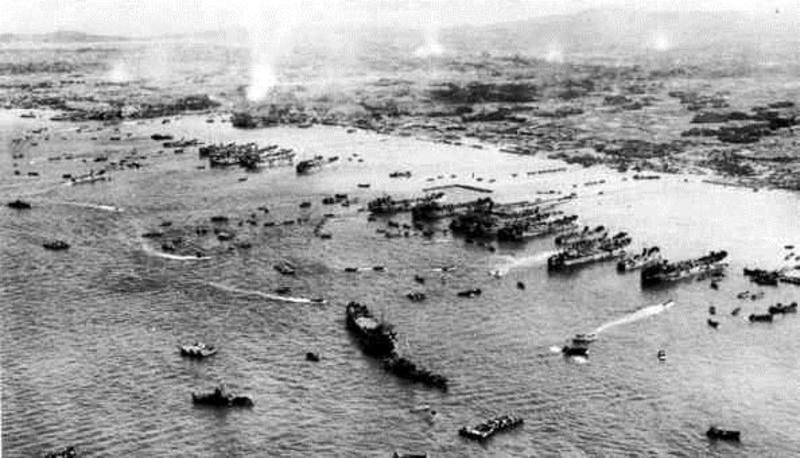
 US Marine landing April 1, 1945 (Aerial view) US Marine landing April 1, 1945 (Aerial view)
|
Early in the morning of 1 April 1945, a fleet of 1,300 vessels landed US forces on the beaches at Chatan and Yomitan either side of the mouth of the Hija River on the west side of central Okinawa. It was the start of fierce fighting that would last three months.
The IJA unit that faced them was known as the Gaya Detachment, named after its commanding officer, Lt. Col. Gaya Kokichi. It was deployed ahead of the main defenses to fight in isolation. By 6 April, when it was deemed to have completed its mission, it had lost six officers and 232 soldiers.
A youth unit comprising local children under 18 years of age was assisting the Gaya Detachment. “We were attached to the Murakami Unit and the duty for the boys was to carry ammunition, while the girls were to help the nurses,” said Yagi Seiei, who was then 17 years old. The 14 or 15 people in this youth unit had been thrown together one day after an order was suddenly given for them to assemble.
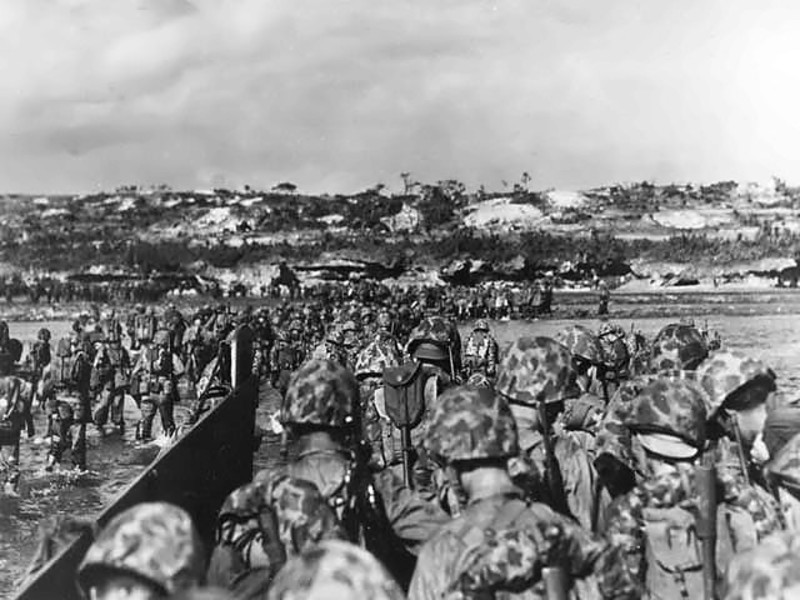
 Marine landing April 1, 1945 (ground view) Marine landing April 1, 1945 (ground view) |
“Cpl. Murakami was in charge of the unit. He was a wild character, to say the least. It was a light machine-gun squad made up of about 20 men.” Before the youth unit was organized, Yagi had been drafted into an agricultural unit and sent to the Ginowan Agricultural School. From there, he went to work for a family that was struggling to complete all the work on the farm because they had a son fighting at the front. “There was a Japanese flag flying from a pole in the middle of the fields. Maybe for about two months… our job was to carry ammunition from a shelter about 200 or 300 meters from an emplacement set up on a highland. Normally we spent time in the local civilian shelter before going out at night to do our shift carrying the ammunition.” At that stage, in Kiyuna where they were, each family had dug its own shelter and for a while Yagi spent time in one of them. However, when the air raids increased in intensity they decided that the family-made shelters were not safe enough, so they moved to the five caves in the area. The sea in front of Chatan was full of warships from about four or five days before the US landings, so Yagi was close enough to sense that the landings could happen any day. The shelter where the gun emplacement was located is in what is now Camp Zukeran, and has a panoramic view of the Chatan coastline. “On the evening of 31 March, I’d just gone on duty,” said Yagi. Early the next morning, the vessels out at sea started to move towards the beaches. “Cpl. Murakami watched this through his binoculars and after checking his watch shouted ‘Landing commences at 6:48am.’”
According to various books on the Battle of Okinawa, the US forces landed at 8:30am, but Yagi says, “There is no mistaking the fact that it was 6:48am. The corporal checked his own watch and then shouted out for someone to check the time. The position of the sun in the sky also meant that it couldn’t have been after 8:00am,” insists Yagi.
He describes the landings as follows. “In those days there were railway tracks running between the coastline at Chatan and the prefectural road [now Route 58]. The unmanned Chatan Railway Station was located centrally between the two. There were smaller roads branching off from the railway station, one going along the prefectural road and the other connecting the prefectural road with the coast. The landings started with three amphibious tanks in the vanguard and behind them waves of troops came ashore from the warships sitting off the coast. The three tanks took the narrow road towards the main prefectural road, where one turned towards Naha, one towards Nago and one headed for Zukeran.
When the US troops first came ashore they expected to come under fire so they immediately took cover, but they relaxed and started to walk around when they realized that no one was shooting at them. “They marched along the nearby riverside, just like the Imperial Army used to do,” said Yagi. That day, when Cpl. Murakami heard that US forces had entered the settlement of Aniya, he flew into a rage and said that the unit would launch an infiltration raid on the enemy.
On the night of 1 April, after having waited in a shelter with ammunition ready to carry, Yagi was ordered to go to a fortified shelter. Just when he got to the area below the plateau where the position was, the ground was shaken by the force of a direct hit on the very position he was heading for. He scrambled up to the emplacement but there was nothing left, just bloodied shreds of uniform on the remaining wooden supports of what had been the shelter. “The guys who had been killed were a lance corporal and a first year recruit. I’m pretty sure that I’d heard that the young soldier was from Shikiya in Chinen,” said Yagi. The lance corporal had been firing his machine gun and the recruit beside him had been feeding the ammunition belt.
Yagi hurried back to the shelter where he’d been waiting before he went out to carry the ammunition and when his shift ended for the day he returned to the shelter for local civilians.
In the evening of 2 April, when Arakaki Masahiro, another member of the youth unit was on his way to the cave where they used to wait for orders to carry ammunition, he quickly hid when he heard a noise from the field nearby. A few moments later he heard people talking. It sounded like there were two people there, one speaking in a loud voice and the other in much quieter tones. He listened hard to pick up what they were saying and could tell that they were speaking in the Okinawan dialect, talking about a noise that they had heard from the field. Yagi joined in, saying that it was probably the enemy that they had just heard. “I’d say that the enemy heard them talking,” said Yagi, because in just a short time, bullets rained in on them as they scurried back to the local civilians’ shelter.
“The American soldiers had dug a hole in the field and were hiding there,” said Arakaki. The boys in the youth unit were divided into two sections with Yagi and Arakaki in separate groups. On the evening of 2 April, the day after the US forces landed, Arakaki went to the civilian shelter to await orders. It was there that he was wounded in his left thigh. “We were standing in a line, one behind the other, a young recruit called Teruya at the front, then LCpl. Sakuma, and me when a shell landed right in front of us. Teruya and Sakuma were killed instantly and I was hit in the left thigh.” Just moments before that, another young soldier called Shimabukuro had been killed when a piece of shrapnel hit him in the chest.
Dragging his wounded leg, Arakaki headed for the shelter at Nodake. On 4 April, he was taken prisoner and put into a camp at Chatan. “The camp was within what used to be the Hamby Airfield, but many of the people there died, so they dug large pits with caterpillar tractors and buried them.
Yagi said that at around noon on 3 April, a second generation Japanese American came to the shelter where local people had sought refuge and persuaded Yagi to surrender together with some 250 other civilians.
The cave that the Murakami Unit operated from, and the civilian shelter at Kiyuna, are now inside Camp Zukeran. Yagi and Arakaki guided me to where I could see them through the barbed wire. There is a tomb across from the base and the road. Yagi said, “I remember some American soldiers cooking food where that tomb is.” The tomb was only a very short distance from where we were standing.
“The young recruits Teruya and Shimabukuro who were killed right in front of me, all I know is their surnames so there’s nothing I can really do to link to anyone with just that. The families are probably searching for information about them too…. In those days new recruits in their first year of service were treated just like any other soldier. They were older than me and I was afraid of them, so I never had a chance to ask their first names. I of course wish that I had…”
Yagi, who witnessed the US forces landing said, “The US fleet out there was just huge. The scale of their flotilla meant that the result of battle was never in doubt.”
On 1 April, the US forces landed with no losses and before the end of that day had occupied the northern (Yomitan) and central airfields (Kadena), and issued Proclamation No. 1 (The Nimitz Proclamation) to set up the US Military Government in Yomitan.
How strategic decisions in the Battle of Okinawa affected civilians
With the fall of Saipan and the other Mariana Islands in mid-1944, the Absolute National Defense Zone created by Imperial Japanese Headquarters (IGHQ) for the defense of the main islands and the continuation of the war was compromised.
As the situation in Japan’s Pacific defense perimeter rapidly deteriorated, in February 1945 the Emperor rejected Prime Minister Konoe Fumimaro’s advice to end the war immediately, insisting instead that Japan fight on in the hope of achieving one last military success. His hope was that this would force the United States and its allies to offer peace terms that would allow Japan to maintain the status and institution of the Emperor.
31 Had the Emperor heeded Konoe’s advice and surrendered, it is possible that there might never have been a Battle of Okinawa, or atomic bombs dropped on Hiroshima or Nagasaki.
However, the Emperor’s belief in the need for one last victory and military hardliners’ intransigence meant that Okinawa would be sacrificed in an attempt to save the main islands of Japan from the disaster that invasion would visit upon the imperial hierarchy.
32 The decision to engage in a battle specifically designed to be drawn-out to cause maximum losses to the enemy and the approach that demanded that civilians also be prepared to make the ultimate sacrifice doomed the people of Okinawa to a level of suffering that was of little concern to the Japanese authorities.
33
Airfields on Saipan, Guam and Tinian allowed US B29 bombers to attack key targets in the main islands of Japan. The next step was to invade either Taiwan or Okinawa, but the lack of sufficient troop numbers to be confident about subduing the Japanese defense force on Taiwan meant that Okinawa loomed as the better option of the two.
34 Its location south of Japan also meant that its airfields and anchorages needed to be secured by US forces before the planned invasion of Japan was launched. In response to the loss of the Marianas, as part of Operation Sho-Go II, the Japanese also recognized the significance of projecting airpower from Okinawa, but from the unrealistic standpoint that the American invasion fleet could be destroyed at sea by Japanese air and naval forces, and that the 32nd Army would then repel any US forces that did manage to land.
35 In late 1944, work to complete 15 airfields in Okinawa went ahead at a frantic pace.
36 However, in the end, because Japanese air-power had been dramatically reduced in the battles off the Philippines, the Japanese destroyed the airfields with their own hands before the American landings.
37
In November 1944, after reinforcing Okinawa with powerful army units, in response to US forces having landed in Leyte Gulf in the Philippines the previous month, the 32nd Army’s best division, the 9th, which represented one third of the 32nd Army’s infantry strength, was redeployed to Taiwan.
38 39 The elite 9th Division, with its large numbers of Okinawan recruits, was not replaced. By this stage of the war, movement of troopships on the seas south of Japan was a perilous operation as evidenced by the sinking of the
Toyama-Maru on 29 June 1944 in which the 44th Independent Mixed Brigade, bound for Okinawa, lost over 5,000 men. In addition, the increasing fixation on strengthening homeland defenses saw Okinawa effectively left to its own designs within a new plan, Operation Ten-Go that focused heavily on so-called “Special Attack Units” including the kamikaze offensives of early April and the suicide mission of the battleship
Yamato.
40 In mid-February, six weeks before the US landings on the main island of Okinawa, when Lt General Ushijima announced the battle slogan of the defense force as “One Plane for One Warship, One Boat for One Ship, One Man for Ten of the Enemy or One Tank,” it was clear that all were expected to give their lives in order to cause maximum damage to the enemy.
41
The redeployment of the 9th Division and the subsequent cancellation in late January 1945 of the dispatch of the 84th Division to Okinawa required the 32nd Army to review its approach to the defense of Okinawa.
42 Rather than spread its depleted resources all over the main island, it decided to concentrate them in the southern region in order to fight a strategic delaying action from static defensive positions.
43 The lack of a replacement unit for the 9th Division meant that locals were required to fill the gap so that after two rounds of conscription, by February 1945, 110,000 Okinawans, almost one quarter of the prefecture’s population, had been called up either drafted into the military or in service as the youth corps, nurses or laborers.
44 This irrevocably linked the fate of local people to that of the 32nd Army, which had by that stage had effectively been abandoned by Tokyo as it focused its attention on preparation for the coming decisive battle on the Japanese main islands.
45
After the failed offensive of 4-5 May, the commanders of the 32nd Army weighed their options on 22 May and decided that they could earn time and inflict heavier losses on the Americans by withdrawing southwards rather than committing their forces to a fight to the death at Shuri.
46 Helped by days of torrential rain, by the end of May the remnants of the 32nd Army slipped away from the noose closing in on Shuri and retreated towards Cape Kyan in the southwest corner of Okinawa. That the 32nd Army commanders chose to prolong the battle for as long as possible by its 30,000 survivors retreating to an area where 100,000 civilians had already converged led ineluctably to 80 percent of the civilian deaths in the Battle of Okinawa.
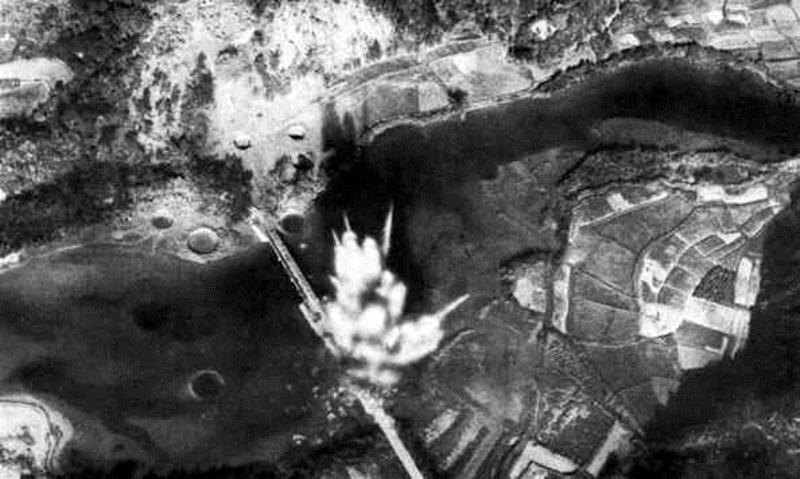
47 The US artillery and naval bombardment was so intense following the withdrawal from Shuri that key crossroads and bridges flooded with fleeing civilians and soldiers became targets for concentrated enemy fire. Bridges south of the Shuri Line at Madanbashi, Ichinichibashi and Yamakawa became known as the “Bridges of Death,” and the Haebaru Junction as the “Crossroads of Death.”
48
While the Japanese Army decision to not to make a last stand at Shuri and instead to withdraw towards Cape Kyan ultimately led to the terrible civilian casualties of mid to late June, it should be noted that U.S. commander Lt. Gen. Simon Bolivar Buckner has also been criticized for his conservative strategy and costly approach in the deployment of his forces.
49 Had he been able to bring the battle to a conclusion earlier, the civilian death toll would not have been as high as it was.
After Lt. Gen. Ushijima’s refusal to respond to Buckner’s plea for a Japanese surrender on 17 June, and then Buckner’s death in action at Maehira the next day, the ferocity of the US forces’ “mopping-up” operations intensified.
50

US bombing during the battle
|
As the carnage continued, in the Headquarters cave at Mabuni on 18 June Ushijima issued his last order, “The battlefield is now in such chaos that all communications have ceased. It is impossible for me to command you. Every man in these fortifications will follow his superior officer’s orders and fight to the end for the sake of the motherland. This is my final order. Farewell.” To this, his chief of staff, Lt. Gen. Cho added: “Do not suffer the shame of being taken prisoner. You will live for eternity.”
51 After urging their troops to “fight to the end,” within four days, both the commanders of the 32nd Army, Ushijima and Cho, had taken their own lives, thereby removing the opportunity for the remaining Japanese troops to carry out an organized surrender which would have helped to avoid the final “mopping-up” operations that claimed so many civilian victims.
52
Kyosei-renko: forced migration of Korean workers to help Japan’s war effort
As the protracted fighting in China and the Pacific resulted in a labor shortage for Japan’s war effort, in October 1939 the process of
kyosei-renko (forced migration) began by which tens of thousands of men and women from Korea, which had been annexed by Japan in 1910, were sent to Japan. Between 1939 and 1945 a total of 670000 young Koreans men were sent to the main islands of Japan as laborers
53 and, while precise numbers are unknown, it is thought that between 600 and 800 women, plus as many as 10,000 or more men were
54sent to Okinawa.
Some of the men were drafted into the Japanese army
55 and actually fought in battle, although most served as military laborers (
gunpu) building shelters and military facilities.
56 As the fighting reached Okinawa,
gunpu were allocated the most dangerous tasks of transporting ammunition, guarding army shelters and hunting for food while exposed to enemy fire. Often banned from taking refuge in the shelters themselves, they worked long hours, suffered discrimination (including from local Okinawans), brutal beatings and some of the highest mortality rates of the battle.
57 Weakened from malnutrition, those caught stealing food would be shot by Japanese soldiers,
58 as were any who were caught trying to escape or surrender.
59 Three of the most notorious incidents involving
gunpu occurred on the Kerama Islands of Tokashiki and Aka where substantial numbers of Korean laborers were stationed. Some were shot for supposedly spying and stealing food, while on Aka fifty were accused of trying to escape. They were forced to dig a cave and were then herded into it after which thirteen were executed “as an example to the others.” On Tokashiki-jima, eight
gunpu were accused of trying to assist the enemy and were summarily beheaded.
60
The plight of the
ianfu (comfort women) was no less appalling. They were forced to provide sexual services to Japanese troops.
61 The women lived and worked in what were euphemistically called “comfort stations” (
ianjo), the first of Okinawa’s
ianjo having been established on Ie-Jima off the west coast of Okinawa in June 1944.
62 About 130 stations were set up in all regions of Okinawa prefecture,
63 and private houses were frequently commandeered for this purpose, often with nothing more than a blanket as the dividing wall between women.
64 Almost all of the
ianfu were Koreans (a small number were Okinawan women), including young girls and mothers, tricked or kidnapped directly from Korea.
65 Ordered to serve dozens of men a day in unsanitary conditions, many also suffered abuse and violence. After the battle ended, US troops used several existing comfort stations, although within a few weeks these were closed down by the US military authorities. However, the Americans also established new stations and drafted captured Korean comfort women to work there.
66 Often simply recorded as “military goods,” many
ianfu were killed in the fighting, while others subsequently took their own lives. At the end of the war, fewer than 3,000 Korean survivors (men and women) were in American custody,
67 meaning that as many as 8,000 may have been killed in the Battle of Okinawa.
Excesses committed by the Imperial Japanese Army
In the last year of World War II, 66 years after Okinawa’s 1879 incorporation as a prefecture of Japan, Japanese interpreted the cultural differences they found on Okinawa as a reason to look down on the locals as second-class citizens. By and large, Okinawans were judged to be unconcerned about the fate of the nation and unable to be trusted to contribute to the protection of the Empire in its time of greatest need.
Their innate prejudice against any form of ethnic difference, fanned by the strain of knowing that the battle could only have one outcome for the defending force, produced a mindset among Japanese soldiers that led to a range of excesses against Okinawan civilians.
In the early stages of the campaign there were instances of locals being killed for “impeding the war-effort” by failing to cooperate in a satisfactory manner with the military.
68 As the situation steadily worsened, many civilians were murdered by the army on the pretext of being “spies.”
69 Anyone who had been in contact with the American forces or held a flier giving instructions to civilians on how to surrender ran the risk of summary execution. On Kume-jima in the last two months of the war, the killing of civilians continued after the main island of Okinawa was secured by US forces, with the last murders of locals on Kume-jima occurring in August, after Japan had surrendered.
70
By 1945, the combat units of the IJA were made up to an ever-increasing extent by older conscripts including men who just a few years previously would not have passed the physical tests for entry to the military.
71 Following the withdrawal southwards from Shuri, discipline within the 32nd Army deteriorated rapidly and there were many instances of theft of food from civilians and rape of local women. There were occasions when infants sheltering in caves with their mothers were killed by soldiers who feared that the child’s crying might give away their location. Civilians were also killed for refusing to go out into the maelstrom on what were effectively suicide missions to collect water or carry boxes of ammunition.
In the final stages of the battle, Japanese soldiers often ejected civilians from caves, effectively sending them to their deaths in the US bombardment. In the final two or three weeks of the battle, literally thousands of Okinawans were killed in the “Typhoon of Steel” directed at the remnants of the 32nd Army following the withdrawal towards Cape Kyan and Mabuni, with over 10,000 children under the age of 14 dying in this manner.
72
Execution of a “spy”
“There is something that I haven’t been able to talk about since the war. It’s about Uehara Tomi, a young woman from Tomigusuku.” The face of lawyer Kawasaki Masanori, who had been a member of the Blood and Iron Student Corps, assumed a pained expression as he readied himself to tell the story. He had had to wait almost 50 years before he could talk about what had happened.
One day in May 1945, Kawasaki remembers that the sun was going down and it was starting to get dark. Some
Kempeitai (military police) dragged a woman out of the 32nd Army’s No. 6 Tunnel. Her name was Uehara Tomi and she was about 30 years old. She wore an army issue short-sleeved jacket and shorts and her hair had been shaved very short. The name uttered by one of the
Kempeitai men etched itself in Kawasaki’s mind. “All spies will receive the same punishment as Uehara Tomi.”
The
Kempeitai man said, “We will now execute a spy.” Uehara Tomi was in a kneeling position, tied to a power pole some 20 meters from the tunnel entrance. Four or five Korean comfort women from the tunnel complex were standing in front of her, each wearing
hachimaki headbands emblazoned with the rising sun and each holding a 40-cm long bayonet.
As the
Kempeitai man controlled the timing by barking out orders of “next,” “next,” the comfort women took turns stabbing the kneeling woman. The
Kempeitai man then cut the rope tying Uehara to the pole and forced her into a sitting position. Kawasaki said, “He was either a first or second lieutenant. I remember that, as he held out his officer’s sword, he said that he wasn’t very skilled in swordsmanship.” The officer stood behind Uehara and swung the sword down on her from above. He severed her head with the second blow. At that moment, some soldiers or young members of the Blood and Iron Student Corps who had been watching came running over, picking up clods of soil or stones to throw at Uehara’s now decapitated body – human beings ceasing to be human. Caught up in the maelstrom of war, those young people who had lost classmates took their feelings out on Uehara’s body.
“I’ll never forgive myself for that,” Kawasaki said, still tortured by his conscience. Fourteen or 15 years after the war’s end, Kawasaki visited the spot where it had happened. “As one of the people who witnessed her last moments, I am obliged to say something. With circumstances as they were in Okinawa at that time, there was no way that people would act as ‘spies.’” For more than twenty years, Kawasaki had thought of writing about the fate of Uehara Tomi, but he was never able to bring himself to put pen to paper.
This year, in the days before
Irei no Hi (June 23, Okinawa Memorial Day) Kawasaki again visited the place in Kinjo, just south of Shuri, where Uehara Tomi is believed to have been buried. He prayed for her soul to be at peace, but in his heart the turmoil of the Battle of Okinawa continues unabated.
US excesses
American troops on Okinawa did not pursue a policy of torture, rape, and murder of civilians as Japanese military officials had warned. In fact, the official policy was to take prisoners where possible and to protect civilians.
73However, while many US soldiers performed acts of humanity far beyond the Geneva Conventions’ requirements, and while civilian prisoners were generally well treated,
74 American troops were not infrequently involved in rape, killing soldiers and civilians attempting to surrender and mistreating prisoners.
Civilian rape was “… one of the most widely ignored crimes of the war… most Okinawans over the age 65 either know or have heard of a woman who was raped.”
75 Even in POW camps, the rape of civilian women was common, including in broad daylight, as Americans conducted “girl hunts” through the rows of tents.
76 Also, while numerous reports testify to the fairness by Americans inside POW camps, in direct contravention of the Hague Conventions, many Okinawans were forced to donate blood, construct military facilities and transport ammunition.
77 Refusing to accept surrender or killing Japanese soldiers who had already surrendered was “widespread in some areas.”
78American troops frequently “… shot groups of Japanese soldiers who emerged after being promised safe capture,”
79 including enticing them from their caves with chocolate and tobacco.
80
A separate, but related, category of the excesses mentioned above was the often tragic contact between US forces and civilians trying to relocate at night, hiding in caves or killed by US military action. For example, Joe Drago of I Company 3rd Bn 22nd Marines Sixth Marine Division, recounted his experience of seeing Okinawan civilians killed as they approached the US perimeter at night, probably around 4 or 5 April as the Sixth Marines advanced northwards towards Motobu Peninsula. Understandably nervous about night-time infiltration raids, US forces had dropped leaflets telling civilians not to move at night, but such information of course did not reach every group of desperate locals. Drago recalls, “When dawn came [we] left our foxholes, observed the carnage strewed about the road … untold numbers … women, old men, children. My guesstimate, in the hundreds.”
81
Another tragic and more common occurrence was the death of civilians in caves in the area of southern Okinawa after the remnants of the Japanese 32nd Army had retreated from Shuri. US troops often appealed to civilians through interpreters, or in broken Japanese, to come out and surrender. However, the presence in a cave or dug-out shelter of just a few IJA soldiers prepared to fight to the death, or the inability to react quickly enough to the appeal to surrender, often proved fatal. One shot fired from inside the cave by a single Japanese soldier would invite a reaction that might involve a satchel charge or white phosphorus grenades being thrown in, a blast from a flamethrower, TNT being inserted into a hole drilled above the cave and detonated to collapse the ceiling onto the people in the space inside, or even gasoline being poured in and lit. The tragedy of the attack on the No. 3 Surgery Cave in Ihara on 19 June 1945 is typical in this respect.
82
A third aspect involved Okinawan civilians falling victim to US pursuit of “military objectives.” There are two notable examples of this: the bombing and strafing of Naha City on 10 October 1944, and the furious bombardment targeting the roads in the southern area of Itoman in mid-June.
The air raids of 10 October involved five waves of attack over a period of nine hours on targets throughout the prefecture. the fourth and fifth raids focused on the city of Naha. Almost half of the 1,300 killed or wounded were civilians, and 90 percent of the city was burned to the ground.
83 This was a preview of US indiscriminate bombing that would destroy much of urban Japan in 1945.
84
While civilians were caught in the crossfire throughout the Battle of Okinawa, it is important to note that more than 80 percent of the civilian deaths occurred from June onwards after the battered remnants of the Japanese army withdrew southwards to the area where as many as 100,000 civilians had fled. After the last tenuous defensive line between Yaezu-dake and Yoza-dake collapsed on 9 June, the Americans commenced “mopping up” operations. Some commentators suggest that the slaughter of Japanese soldiers and civilians that occurred in the area north of Mabuni was an act of revenge for the death of Lt. Gen. Buckner at Maezato on 18 June.
85
This article has been adapted from Descent Into Hell – Civilian Memories of the Battle of Okinawa, which is based upon the
Senka o Horu series of articles published by the Ryukyu Shimpo from 1983-85. The English translation was published in 2014
http://merwinasia.com/books/2014/Descent_into_Hell.php
Ota Masahide is an Okinawan academic and politician who served as governor of the prefecture from 1990 to 1998. He has written many books on Okinawa, of which the best known is his account of the Battle of Okinawa as he saw it as a high school student member of the Blood and Iron Student Corps. Ota had a distinguished record as governor, defending the interests of the Okinawan people against both the United States military establishment in the prefecture and the Japanese central government.
About the translators
Mark Ealey is a freelance translator who specializes in modern Japanese history and has focused on Okinawan issues in recent years. Previous translations of non-fiction are Phoney Alliance – Anglo-Soviet Diplomacy in 1941 by Akino Yutaka, Japan of the East, Japan of the West by Ogura Kazuo, The Kurillian Knot – A History of Russo-Japanese Border Negotiations, by Kimura Hiroshi and of historical fiction are Shipwrecks, One Man’s Justice and Typhoon of Steel, all by Yoshimura Akira.
Alastair McLauchlan was a French/Japanese translator and author who published widely in a range of international journals. He published two major English translations, namely Where are the Sunflowers by Kurihara Miwako andThe Buraku Issue: Questions and Answers by Kitaguchi Suehiro, and two original books based on his own research, The Negative L2 Climate: understanding attrition among second language students (Palmerston North: Sasakawa, 2007) and Prejudice and Discrimination in Japan: The Buraku Issue (New York: Edwin Mellen Press, 2003). Alastair passed away just weeks before Descent into Hell was published.Recommended citation:
Recommended citation: Ryukyu Shimpo, Ota Masahide, Mark Ealey and Alastair McLaughlan, Descent into Hell: The Battle of Okinawa. The Asia-Pacific Journal, Vol. 12, Issue 47, No. 4, December 1, 2014.
http://www.globalresearch.ca/the-final-stage-of-the-pacific-war-descent-into-hell-the-battle-of-okinawa/5417792